The 401(k) was designed to run itself, and that is precisely the problem. Sign-up happens once, the deductions go out quietly, and most people never look again for years. Autopilot is wonderful when the default settings are good and brutal when they are not. The most expensive 401(k) mistakes are not dramatic blowups; they are small, invisible leaks that compound for decades until they cost you a house worth of retirement money. None of them require bad luck. They just require not looking.
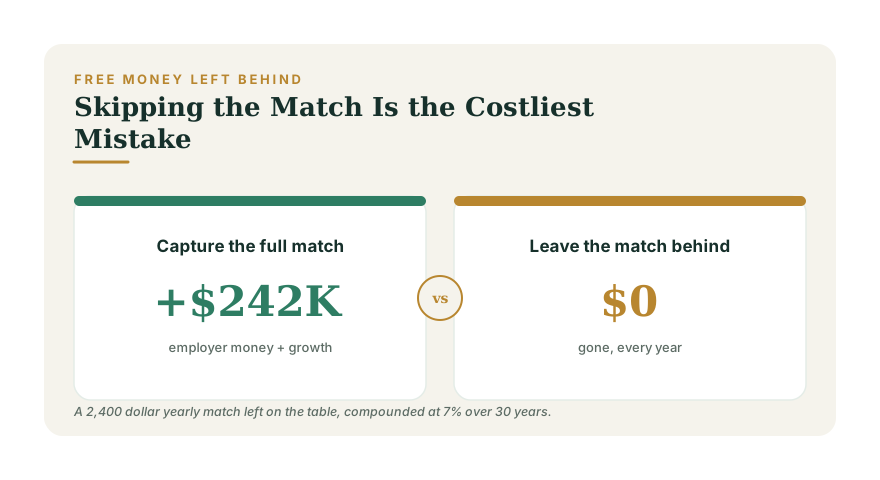
Mistake 1: not capturing the full employer match
This is the only place in personal finance where someone hands you a guaranteed, instant 50% or 100% return, and people walk past it. A common match is 50 cents on the dollar up to 6% of pay, or dollar-for-dollar up to a smaller percent. If you contribute less than the threshold, you are declining free money your employer already budgeted for you.
Say you earn 80,000 dollars and your employer matches 50% up to 6%. Contributing 6% (4,800 dollars) earns you a 2,400-dollar match every year. Skip it, and you forfeit 2,400 dollars annually. Invest that forfeited match at 7% for 30 years and you have given up roughly 240,000 dollars. The match alone, the part that costs you nothing, is a quarter-million-dollar decision.
Mistake 2: leaving the money in cash or an over-conservative default
Many plans default new enrollees into a money-market or stable-value option, or an overly conservative setting, and the money sits there earning almost nothing. People assume that because they are "in the 401(k)," they are invested. They are not; they are parked. Over 30 years, the gap between cash and a diversified stock-heavy portfolio is enormous. Contributing diligently and leaving it all in cash is like filling a car with gas and never starting the engine.
Mistake 3: paying for a high-fee fund menu
Plenty of 401(k) menus are stuffed with actively managed funds carrying expense ratios of 0.75-1.25%, plus sometimes an administrative layer on top. As we cover in our piece on expense ratios, a 1% annual fee can quietly erase six figures over a career, because it is charged on your whole balance every year, in good markets and bad. Consider two identical savers who each build a 400,000-dollar balance: the one paying 1.00% instead of 0.10% surrenders roughly 4,000 dollars a year in that single year, and far more in the years that money would have kept compounding. You usually cannot fix a bad menu, but you can almost always find the cheapest broad index option in it and route your money there. If the entire menu is expensive, contribute just enough to grab the match, then send additional retirement savings to a low-cost IRA where you control the fees.
Mistake 4: cashing out when you change jobs
When people leave a job, a startling share cash out their 401(k) balance instead of rolling it over. The damage is triple: the withdrawal is taxed as ordinary income, there is typically a 10% early-withdrawal penalty if you are under 59 and a half, and worst of all, that money stops compounding forever. Cashing out a 20,000-dollar balance at 30 might net you 13,000-14,000 after tax and penalty, while that same 20,000 left invested at 7% would have grown to over 150,000 dollars by your mid-sixties. You are not spending 20,000; you are spending 150,000.
Mistake 5: ignoring the Roth 401(k) option
Many plans now offer a Roth 401(k), and a lot of people never notice it. A traditional 401(k) gives you a tax break now and is taxed in retirement; a Roth is funded with after-tax dollars and comes out tax-free later. Neither is universally better, but young savers in a low bracket and anyone expecting higher future tax rates often benefit from locking in today's rate with Roth contributions. Crucially, the employer match itself is contributed pre-tax regardless, so choosing Roth for your own contributions does not cost you the match. Not even considering the choice means you may be optimizing for the wrong decade of your life.
Mistake 6: forgetting old accounts
Change jobs a few times and you scatter 401(k)s across former employers, each with its own login, fees, and forgotten allocation. Old accounts drift, sit in stale funds, sometimes get force-cashed-out of small balances, and quietly bleed fees. Consolidating old 401(k)s into an IRA or your current plan gives you one view, usually cheaper funds, and far less chance of losing track of real money.
Your 401(k) tune-up checklist
- Contribute at least enough to capture the full employer match, no exceptions.
- Confirm your money is actually invested, not sitting in cash or a too-conservative default.
- Find the lowest-fee broad index fund in your menu and concentrate there.
- At every job change, roll over, never cash out.
- Decide deliberately between traditional and Roth contributions.
- Track down and consolidate old accounts from past employers.
The honest recommendation
Treat your 401(k) like a machine that needs an annual oil change, not a set-and-forget appliance. Once a year, spend twenty minutes: verify the match, check the allocation, look at the fees, and clean up old accounts. The match is the single highest-return move available to you, so that is non-negotiable; the rest is about not letting small leaks compound for thirty years. None of this requires you to pick winning stocks or time the market. It just requires looking.
If you want to see what fixing even one of these mistakes does to your own retirement number, model it on the wealth simulator, explore the broader tools, or check where your retirement readiness lands on your scores. A quarter-million dollars is a lot to leave on the table for the sake of not logging in.