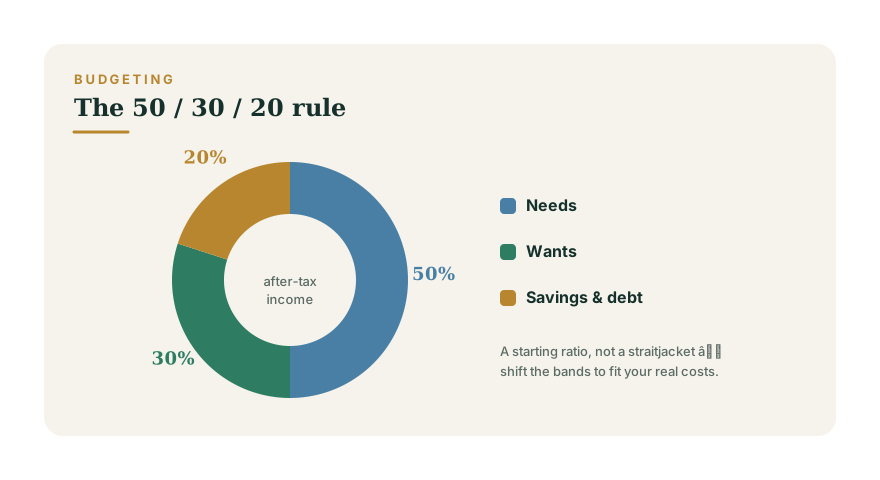
The 50/30/20 rule was popularised by Senator Elizabeth Warren in her book All Your Worth and has since become one of the most widely recommended budgeting frameworks in personal finance. The idea is simple: spend 50% of your after-tax income on needs, 30% on wants, and 20% on savings and debt repayment. Its appeal is its simplicity — no spreadsheets, no dozens of categories, just three buckets.
But like all simple rules, it has limits. Understanding what it is actually measuring — and when to ignore it — makes it far more useful than following it blindly.
What Each Category Actually Means
Needs (50%) — Essential expenses you cannot avoid. This includes housing (rent or mortgage), utilities, groceries, transportation to work, minimum debt payments, and basic insurance. The key test: if you lost your job tomorrow, which expenses could you not cut without serious harm? Those are your needs.
Note that "needs" does not mean "everything I currently pay for." A subscription meal kit service is not a need. A car payment on a vehicle you could replace with a cheaper one is, at least partly, a want. The 50% category is more selective than most people initially think.
Wants (30%) — Expenses that improve quality of life but are not essential. Dining out, streaming services, gym memberships, shopping, vacations, hobbies, and entertainment all belong here. These are things you value and choose to spend on — not things you are obligated to pay.
Savings and Debt Payoff (20%) — Building your future and eliminating liabilities. This includes contributions to 401(k), IRA, emergency fund, and any debt payments above the minimum. If you have high-interest debt, the minimum payment goes to needs (you must pay it), but extra payments go here.
How to Apply It
Start with your monthly take-home pay — the money that actually hits your bank account after taxes, health insurance, and 401(k) contributions are removed. Gross income is the wrong number to use. If your employer takes out health insurance and 401(k) contributions from your paycheck, those are already "spent" before you see the money.
Multiply your take-home pay by 0.50, 0.30, and 0.20 to get your target amounts for each category. Then compare those targets to what you are actually spending. The gap between your current spending and your targets is your action plan.
Where the Rule Works Well
The 50/30/20 rule is most useful as a diagnostic tool, not a daily tracking system. Running the numbers once a quarter tells you which category is out of alignment. If your needs are consuming 65% of your income, you know housing or transportation is the problem to solve — not whether you spent too much on coffee last Tuesday.
For people who find detailed budgets overwhelming, the 50/30/20 rule offers a sustainable alternative. Three categories is manageable. You are not tracking every purchase — you are making sure each major bucket stays within its target range.
When to Break the Rule
High cost-of-living cities. In San Francisco, New York, Seattle, or other expensive metros, it is common for housing alone to consume 35–40% of take-home pay. If you live in one of these cities, demanding that your total needs stay under 50% is unrealistic. Instead, compress the wants category (target 15–20% rather than 30%) and protect the savings category. Treat 50% as a ceiling, not a floor.
Early in your career. If you are aggressively paying off student loans or building an emergency fund, it makes sense to push savings above 30% temporarily by cutting wants. The 20% savings target is a minimum for most people, not a maximum for everyone.
High earners. If you earn significantly above median income, 30% on wants is probably too much. A family earning $300,000 per year does not need to spend $90,000 on entertainment, dining, and lifestyle upgrades. High earners who follow the 30% wants allocation often end up with lifestyle inflation that makes them feel trapped despite high incomes. Push savings toward 30–40% instead.
When paying off high-interest debt. Credit card debt at 22% APR is a guaranteed 22% return to pay it off. In this situation, redirect almost everything from the wants category to debt payoff until high-interest balances are gone. Normal 50/30/20 allocations resume after that.
The One Thing the Rule Gets Right
The most valuable insight in the 50/30/20 framework is not the specific percentages — it is the insistence that savings come first, not last. Most people budget their needs and wants and save whatever is left over. Whatever is left over is usually zero.
By assigning savings its own 20% budget category with the same standing as rent and groceries, the rule forces you to treat saving as a non-negotiable expense rather than an afterthought. That shift in mindset — from saving whatever remains to spending only what remains after saving — is the foundation of every successful financial plan.
Use the 50/30/20 rule as your starting point, adapt it to your cost of living and goals, and revisit it whenever your income or major expenses change. The numbers matter less than the habit of tracking them.