An emergency fund is not an investment strategy, a wealth-building tool, or a retirement vehicle. It is insurance against the financial disruption that comes from losing a job, facing an unexpected medical bill, or watching your car break down on the highway. Its job is to absorb shocks without forcing you to go into debt or sell investments at the wrong time.
Most people either have no emergency fund at all or have one that is too small to matter. Building the right one — and keeping it in the right place — is the most important financial foundation you can establish before anything else.
How Much Do You Actually Need?
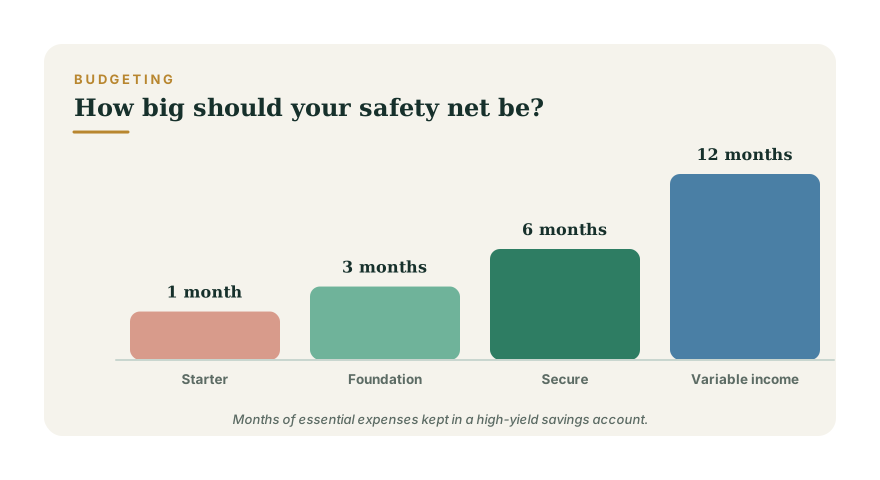
The standard advice is three to six months of expenses. That range is too wide to be useful. Here is how to narrow it down for your specific situation:
Three months of expenses is appropriate if: You have a stable, salaried job in a field with strong demand, your employer provides good health insurance, you have a dual-income household, and you have no dependents or elderly parents relying on your income. If you lost your job tomorrow, three months is enough time to find another one in most industries.
Six months of expenses is appropriate if: You are self-employed, freelance, or have variable income; you work in a specialised or contracting field where job searches take longer; you are the sole income earner in your household; you have dependents; or you have health conditions that make medical expenses unpredictable.
Nine to twelve months makes sense if: You are in a niche profession, run your own business, are over 50 and in a field where rehiring is slower, or live in a region with fewer employment options.
The "expenses" you are targeting should be your actual monthly survival spending — rent, utilities, groceries, transportation, insurance, minimum debt payments — not your current total spending including dining out, entertainment, and extras. You would cut those in a genuine emergency.
Where to Keep Your Emergency Fund
Your emergency fund should be in a high-yield savings account (HYSA) at an online bank. This sounds specific, and it is.
Why not a traditional savings account: Major banks like Chase, Bank of America, and Wells Fargo typically pay 0.01–0.05% APY on savings accounts. On a $15,000 emergency fund, that is $1.50 to $7.50 per year. Online high-yield savings accounts from institutions like Ally, Marcus, SoFi, Discover, or American Express currently pay significantly more — often 4–5% APY depending on the rate environment. The FDIC insurance is identical; the interest is meaningfully better.
Why not in the stock market: The market can drop 30–40% in a recession — exactly when you are most likely to need your emergency fund. Selling investments at a 30% loss to cover a job-loss emergency turns a short-term problem into a permanent one. Emergency funds are not investment accounts. They are liquidity accounts.
Why not in a CD: Certificates of deposit lock your money for a fixed term (3 months, 6 months, 1 year). Early withdrawal penalties typically erase your interest and sometimes cut into principal. An account that penalises you for accessing it in an emergency is the wrong account for an emergency fund.
Why not in a money market fund: Money market funds (distinct from money market accounts) hold short-term securities and are not FDIC-insured. During the 2008 financial crisis, one prominent money market fund "broke the buck" — its value dropped below $1 per share. For money you cannot afford to lose, FDIC insurance matters.
Building Your Emergency Fund When Money Is Tight
The biggest obstacle to emergency funds is not finding the right account — it is finding the money to fill it. A few strategies that work:
Start with a mini-goal. A $1,000 emergency fund stops most small crises — car repairs, medical copays, appliance replacements — from becoming debt problems. Getting to $1,000 is achievable for most people within a few months and provides immediate psychological relief.
Automate a small amount. Even $50 per paycheck is $1,200 per year. The key is automation: set up a recurring transfer from your checking account to your HYSA on payday, before you have a chance to spend it. Start smaller than you think you need to and increase the amount every few months.
Direct windfall money to the fund. Tax refunds, work bonuses, cash gifts, and side income are ideal for emergency fund contributions. A $2,000 tax refund can fill a significant portion of a starter emergency fund without requiring any change to monthly spending.
Temporarily reduce retirement contributions. This feels counterintuitive, but it is mathematically defensible in the short term. If you have no emergency fund and contribute 10% to your 401(k), consider dropping to the employer match minimum (e.g., 4%) for 6 months and redirecting the difference to your emergency fund. Once funded, restore your contribution. High-interest debt is the exception — pay that off alongside building the fund, not instead of it.
Common Emergency Fund Mistakes
Using it for non-emergencies. Predictable irregular expenses — car registration, annual insurance premiums, holiday gifts, home maintenance — are not emergencies. They are planned expenses you forgot to plan for. Keep a separate "irregular expenses" sinking fund and protect your emergency fund for genuine surprises.
Keeping it in your everyday checking account. Money that lives with your daily spending gets spent. The slight inconvenience of a transfer taking one to three business days is a feature, not a bug — it creates a moment of friction before you access the fund, which prevents casual spending while still making money available quickly when genuinely needed.
Stopping once the fund is built. Revisit your target every year. If your rent increased, if you took on a car payment, if you had a child — your monthly survival expenses changed. Adjust your target accordingly.
An emergency fund will not make you wealthy. But it will stop an emergency from making you poor. That is exactly what it is supposed to do.