A 529 plan is a state-sponsored, tax-advantaged account designed to help families save for education. You contribute after-tax dollars, the money grows tax-free, and withdrawals for qualified education expenses are tax-free as well. Think of it as a Roth account that is specialized for education.
What used to be a narrow college-only tool has quietly expanded into something far more flexible.
The core tax deal
There is no federal deduction for contributions, but the growth is never taxed if used for qualified expenses. On top of that, many states offer a state income-tax deduction or credit for contributions to their own plan, and a few are even plan-agnostic. If your state offers a deduction, that is real, immediate money, so check your state's rules before opening an out-of-state plan.
What counts as a qualified expense
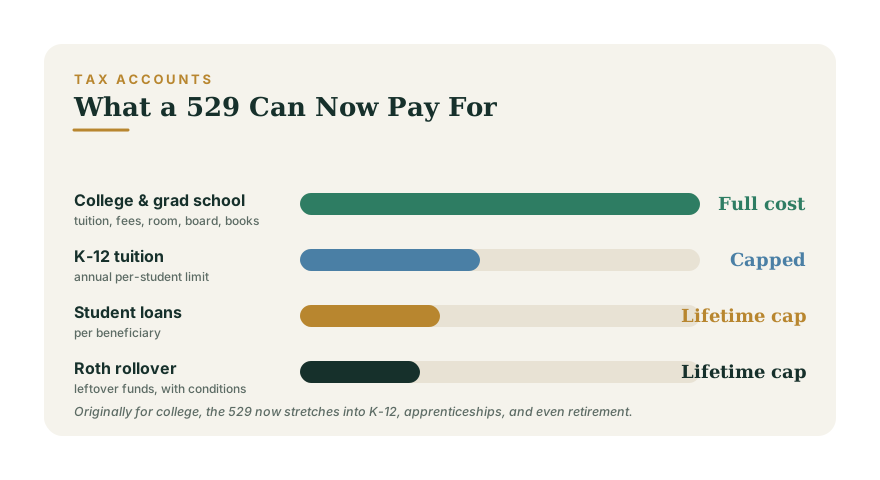
- Tuition and mandatory fees at eligible colleges, universities, and trade schools.
- Room and board for students enrolled at least half-time.
- Books, supplies, and required equipment, including computers.
- K-12 tuition, up to an annual per-student cap.
- Registered apprenticeship program costs.
- Student loan repayment, up to a lifetime cap per beneficiary.
Spend on anything outside these categories and the earnings portion is taxed as income plus a penalty, so keep withdrawals matched to real education costs.
The Roth rollover provision
A relatively new rule eased one of the biggest fears about 529 plans: what if your kid does not need all the money? You can now roll leftover 529 funds into a Roth IRA for the beneficiary, subject to conditions. The account generally must have been open for a number of years, there is a lifetime rollover cap, annual rollovers are limited to the yearly IRA contribution amount, and the beneficiary needs earned income. It is not a loophole for unlimited Roth funding, but it meaningfully reduces the risk of getting trapped.
Financial-aid impact
A 529 owned by a parent is treated relatively favorably in federal aid calculations, assessed at a low rate as a parental asset. A 529 owned by a grandparent has historically been more complicated, though recent changes to the aid formula have softened the effect of distributions from grandparent-owned accounts. The short version: parent-owned 529s have a modest aid impact, and the rules have generally moved in savers' favor.
The overfunding risk
The flip side of tax-free growth is the penalty on non-qualified withdrawals. If you save aggressively and your child earns scholarships, attends a cheaper school, or skips college, you could end up with more than you can spend on education. Options to soften this:
- Change the beneficiary to another family member, including yourself.
- Use the Roth rollover provision for a portion.
- Withdraw an amount matching a scholarship without the usual penalty (earnings are still taxed).
Because of overfunding risk, many families fund a 529 for a realistic portion of expected costs rather than the maximum imaginable bill.
When a 529 makes sense
It is a strong fit if you have a clear education goal, a long time horizon for tax-free growth to matter, and a state tax benefit to capture. It is less compelling if your own retirement is underfunded, since there is no financial aid for retirement. Get the order of priorities right first; map it out at /plan.