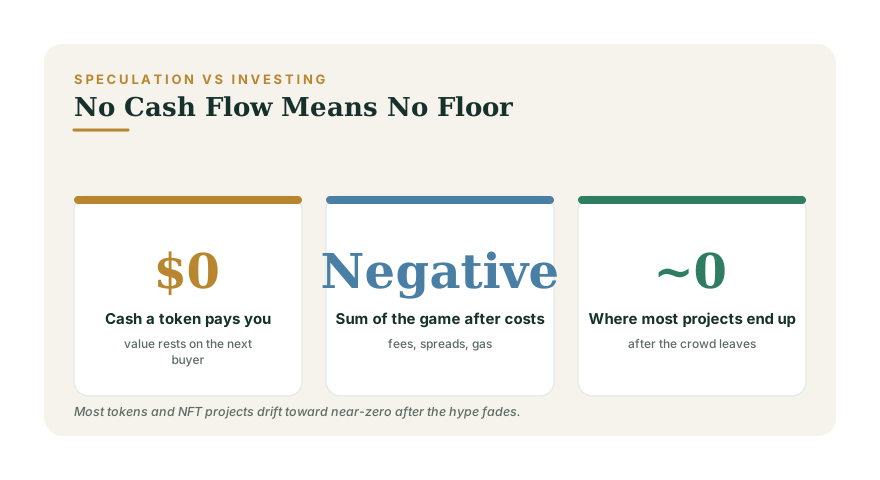
There is a clean line between investing and speculating, and most crypto and NFT activity falls on the speculating side of it. An investment produces cash you can value: a stock pays dividends and owns a slice of real profits, a bond pays interest, a property collects rent. A token or an NFT pays you nothing. Its entire value rests on one assumption, that someone will pay you more for it later. That can absolutely happen. But when the value of a thing depends only on the next buyer being more optimistic than you were, you are not analyzing an asset, you are guessing about a crowd.
The honest truth: no cash flow means no floor
A share of a profitable company has a tether to reality. Even if the price falls, the business is still earning money, paying dividends, and buying back stock, which eventually pulls the price back toward something real. A token with no cash flow has no such tether and no floor. If sentiment turns and buyers stop showing up, there is nothing underneath to catch it. That is why the chart of a hyped token or a once-hot NFT collection so often looks the same: a vertical climb on attention, then a long, quiet slide toward zero as the attention moves on to the next thing.
Follow the money
Every transaction in this world leaks value to a middleman. Exchanges take trading fees. The gap between the buy and sell price, the spread, is wider than in traditional markets and you pay it both ways. On many blockchains, "gas" fees charge you just to make a transaction happen. NFT marketplaces add listing fees and ongoing royalties to the original creator on every resale. None of that value goes to you. It is skimmed off the top of money that is only ever moving between participants, never being created by an underlying business. That is what "negative-sum" means: before anyone wins, the house has already taken a cut, so the players as a group must collectively lose. The promoters, founders, exchanges, and early insiders are the house.
Now the math
Think in terms of expected value, which is the honest way to size any bet. Suppose a new token has, generously, a 5% chance of going up tenfold and a 95% chance of falling to roughly a tenth of its value, which is kind given how many go to zero. The expected return is 0.05 times 10, plus 0.95 times 0.1, which equals 0.5 plus about 0.095, or roughly 0.6. That is an expected value of 60 cents on the dollar before you even subtract fees and spreads. The rare jackpot does not come close to paying for the common loss. That is the structure of a lottery ticket, not an investment.
Now apply it to a portfolio. Put 1,000 dollars into one token with that profile and your expected outcome is around 600 dollars, with a small chance of a thrilling win and a large chance of near-total loss. Put the same 1,000 dollars into a broad index fund at 7% a year and the expected outcome after a decade is roughly 1,970 dollars, with the range of outcomes far narrower and far friendlier. The two are not in the same category. One has positive expected value because it owns real, profit-making businesses. The other is a coin flip weighted against you by fees.
To be fair, this does not mean every person holding crypto is foolish. Some people knowingly put a tiny slice of money, an amount they can fully afford to lose, into it as a lottery ticket for the fun of the gamble. That is a defensible choice when it is honest about what it is. The damage happens when speculation is dressed up as a retirement strategy, when people borrow to buy in, or when "this time it goes to the moon" replaces an actual plan.
How to protect yourself
You do not have to swear it off entirely. You have to size it like the gamble it is and refuse to let it touch the money your future depends on.
- If you cannot explain how the thing produces value in two plain sentences, do not put real money in it.
- Cap any speculation at a tiny share of your investable money, the kind of money you would not miss if it vanished entirely.
- Never invest rent money, emergency savings, or anything you might need in the next several years.
- Never borrow to buy it, and never let an app's leverage features tempt you into it.
- Count every fee, spread, and gas charge in your math, because they quietly turn small losses into large ones.
The honest recommendation
Build your wealth on assets that produce something, broad stock index funds, bonds, and real estate, because their value rests on cash flows rather than on the mood of the next buyer. If you want to keep a small, clearly labeled lottery ticket on the side with money you can truly afford to lose, that is your call, made with open eyes. Just keep it small, keep it separate, and never confuse it with a plan.
Before you move money out of real, productive assets and into something with no cash flow, run the comparison honestly: model the same dollars in a diversified portfolio with the wealth simulator, and use the tools and scores to see whether your foundation is solid first. The boring portfolio is not the cautious choice. It is the one the math is actually on the side of.