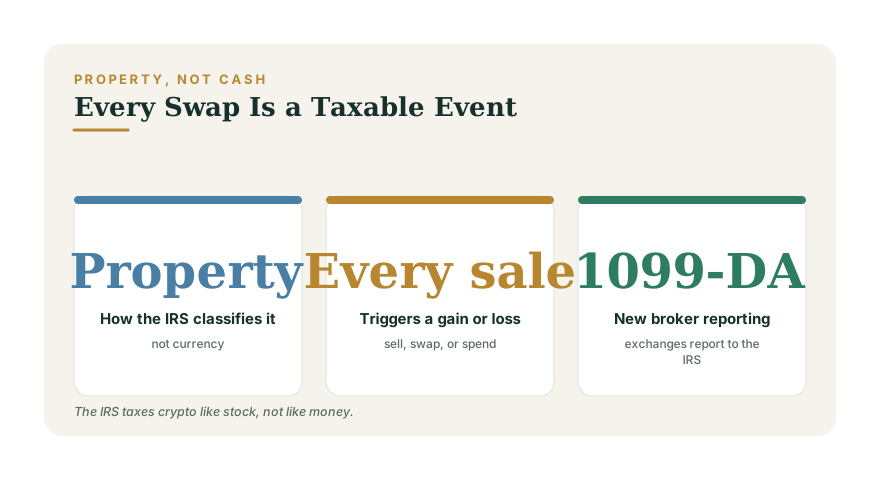
A lot of people treat their crypto like cash in a digital wallet and assume the tax man only shows up when they cash out to dollars. That assumption is wrong, and it is the source of most crypto tax trouble. The IRS does not see crypto as money. It sees it as property, the same category as a share of stock or a piece of real estate. That one classification changes everything, because it means that nearly every time the crypto leaves your hands, even to buy a coffee or swap one token for another, you have triggered a taxable event the IRS expects you to report.
The honest truth: spending crypto is selling crypto
Because crypto is property, every disposal is a sale. Selling it for dollars is a sale. Trading one coin for another is a sale of the first coin. Buying a pizza with it is a sale. Each time, you compare what the crypto is worth at that moment against what you originally paid for it (your cost basis), and the difference is a capital gain or loss you owe tax on. People are stunned to learn that swapping a token they never converted to cash created a taxable gain, but in the eyes of the code, the swap was the cash-out, with the proceeds immediately reinvested.
Short-term versus long-term
How long you held the crypto before disposing of it decides your rate. Hold it a year or less and any gain is short-term, taxed at your ordinary income rate, which can be high. Hold it more than a year and the gain is long-term, taxed at the lower capital-gains rates. The difference is large. A 10,000 dollar gain taxed short-term at 24% costs 2,400 dollars; the same gain held long enough to qualify for a 15% long-term rate costs 1,500 dollars. The hold-period clock is one of the few levers entirely in your control.
Staking and airdrops are income, not gains
Not all crypto tax is capital gains. When you receive new tokens through staking rewards, mining, or an airdrop, the IRS generally treats the fair market value at the moment you receive them as ordinary income, taxed right then, even if you never sold anything. Worse, that value becomes your cost basis, so when you later sell those tokens you also owe capital-gains tax on any further appreciation. You can be taxed twice on the same coins: once as income when you got them, and again as a gain when you sell them.
The real headache: tracking cost basis
This is where crypto taxes become genuinely painful. To report a gain, you need to know exactly what you paid for the specific coins you disposed of, and that history is often scattered across multiple exchanges, self-custody wallets, and transfers between them. Move coins from one exchange to another and the receiving platform usually has no idea what you originally paid. Make hundreds of small trades or use decentralized apps, and reconstructing the basis by hand becomes nearly impossible. Many people who owe modest amounts get into trouble not because they tried to hide anything, but because they simply lost the paper trail.
The reporting net is tightening
For years, crypto reporting was patchy and the IRS relied largely on the honor system. That era is ending. Exchanges are moving toward issuing Form 1099-DA for digital-asset transactions, similar to the 1099-B that stockbrokers already send. The practical meaning is blunt: the IRS will increasingly receive a copy of your activity directly from the exchange, and when their copy does not match your return, you get a letter. Ignoring crypto on your taxes was always risky; broker reporting is closing the gap fast.
Your crypto-tax checklist
- Treat every sale, swap, and purchase made with crypto as a reportable event, not just cash-outs.
- Record the date, the dollar value, and your cost basis at the moment of each transaction, all year long, not in April.
- Track your hold period; crossing the one-year mark can cut your rate substantially.
- Log staking, mining, and airdrop receipts as income at their value on the day you received them.
- Export full transaction histories from every exchange and wallet you use and keep them.
- Use reputable crypto tax software to consolidate basis across platforms; doing it by hand rarely ends well.
- Answer the digital-asset question on your return honestly and confirm current reporting rules at IRS.gov.
The honest recommendation
The two things that save people are tracking basis as you go and not ignoring the problem. If you wait until tax season to reconstruct a year of trades across four platforms, you will either overpay out of confusion or underpay out of exhaustion, and underpaying is the one the IRS notices. Connect your exchanges and wallets to crypto tax software now so the record builds itself, and remember that crypto tax rules are still evolving, so confirm the current-year treatment before you file.
Before you decide crypto belongs in your portfolio at all, it is worth pressure-testing the math against simpler options. Run the comparison through our tools, keep the rest of your house in order with a plan, and read our honest take on crypto returns in our articles.