Ask most people what their most valuable asset is and they will say their house or their retirement account. The honest answer, for almost anyone still working, is their ability to earn a paycheck. A 35-year-old earning 80,000 dollars a year who works to 65 will bring in well over 3 million dollars in future income, even before raises. That stream of money funds everything: the mortgage, the savings, the retirement, the life. And it is the one asset most people never insure.
The honest truth: the risk is bigger than you think
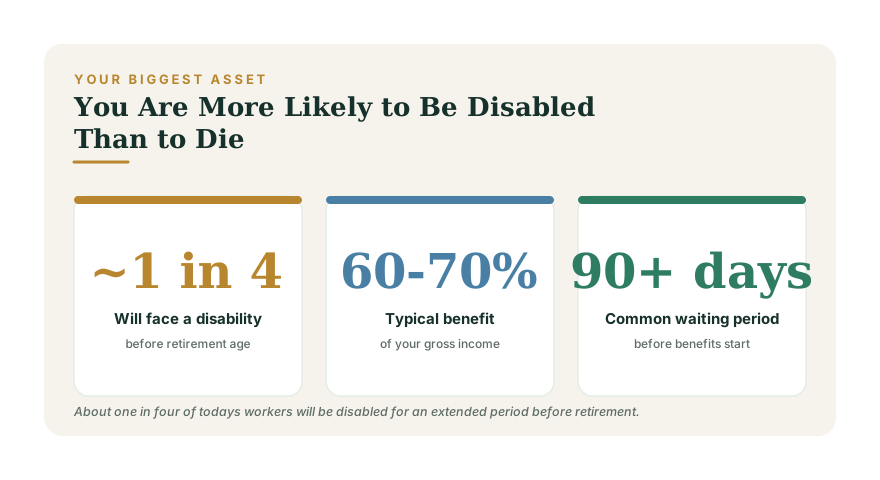
During your working years, you are considerably more likely to be unable to work for an extended period than to die. Roughly one in four of today's 20-year-olds will experience a disability lasting 90 days or more before they reach retirement age. Most long-term disabilities are not dramatic accidents; they are ordinary illnesses and injuries: back problems, cancer, heart disease, arthritis, mental health conditions. These do not just stop your income, they often arrive with new medical bills at the same time.
People diligently buy life insurance to protect their family if they die, then carry almost nothing to protect the much more likely event of being alive but unable to work. That gap is the most common, and most damaging, hole in the average financial plan.
Follow the money
Why is disability insurance so underbought? Partly because it is rarely sold the way commission-rich products are pushed. There is no glamorous illustration to wave around, and the premiums are modest, so the incentive to market it hard is small. Insurers, for their part, price and underwrite it carefully and define "disability" tightly, because they know it is a real risk that gets claimed. The result is a product that is genuinely valuable but quietly sits on the shelf while flashier, higher-commission products get the sales energy. You usually have to go looking for good disability coverage; it does not come looking for you.
The definitions that decide everything
Not all disability coverage is equal, and the fine print is the whole game.
- Own-occupation pays if you cannot perform the duties of your own profession. A surgeon who develops a hand tremor and can no longer operate gets paid, even if they could theoretically do a different job. This is the gold standard.
- Any-occupation only pays if you cannot do any job you are reasonably suited for. It is cheaper and far weaker, because the insurer can argue you could work somewhere else.
- Group (employer) coverage is often any-occupation, capped at a percentage of income, and you lose it if you leave the job. It is also usually short on benefit period.
- Individual coverage that you own travels with you, can be own-occupation, and cannot be canceled as long as you pay. It costs more but it is yours.
The tax twist most people miss
Whether benefits are taxed depends on who paid the premium. If your employer pays for your group coverage, the benefits you receive are taxable. If you pay the premium with after-tax dollars, the benefits are generally tax-free. This matters enormously when you size your coverage. A policy that replaces 60% of your income tax-free can actually leave you close to your take-home pay, whereas a 60% taxable benefit could fall well short.
Now the math: how much you need
Take that 80,000 dollar earner. A typical policy replaces 60% to 70% of gross income, so figure on a benefit of about 4,000 to 4,700 dollars a month. If the premium is paid with after-tax dollars, that benefit arrives tax-free, landing close to normal take-home pay.
- Benefit amount. Aim to replace enough to cover your essential expenses, then push toward 60-70% of gross if you can.
- Elimination period. The waiting time before benefits start, often 90 days. A longer wait lowers the premium, but only choose it if your emergency fund can carry you through.
- Benefit period. How long benefits last. "To age 65" coverage protects against the catastrophic case of a permanent disability; short two-year benefit periods leave a dangerous gap.
How to protect yourself
- Check your employer long-term disability (LTD) first. Learn the definition (own vs any occupation), the percentage replaced, the cap, and the benefit period.
- Identify the gap. Group coverage rarely replaces enough, often stops at a low monthly cap, and may be taxable. Calculate what it would actually pay you.
- Add a supplemental individual policy to fill the gap, ideally own-occupation and "to age 65," paid with after-tax dollars so benefits are tax-free.
- Lock it in while you are young and healthy. Premiums and approval both depend on your health now; waiting until something goes wrong is too late.
- Match the elimination period to your emergency fund so you are not stranded between your last paycheck and your first benefit.
The honest recommendation
If people depend on your income, disability insurance is not optional, it is the foundation. Start with your employer's LTD plan, understand exactly what it would and would not pay, and seriously consider a supplemental individual own-occupation policy to cover the gap. It protects the single asset that everything else in your plan rests on.
Before you decide how much to carry, figure out what your income is actually worth and how much of it you need to protect. Run the numbers through the insurance calculator, then use the broader tools and your scores to make sure your income protection, emergency fund, and savings are all pulling in the same direction.