The letters after a financial advisor's name are supposed to signal expertise. Some genuinely do. Others are marketing - a credential someone bought with a weekend webinar and a fee, designed to look impressive on a business card. There are well over a hundred financial designations in circulation, and the gap between the rigorous ones and the hollow ones is enormous. If you cannot tell them apart, you can be impressed by exactly the wrong thing.
Here is what each of the credentials that matter actually requires - and why some letters should make you ask more questions, not fewer.
CFP: The One Most Worth Looking For
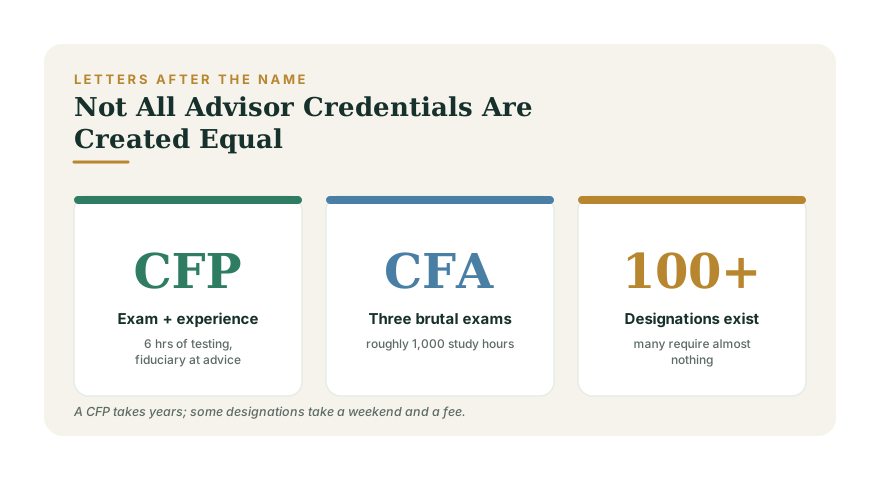
The Certified Financial Planner (CFP) is the most useful broad credential for someone giving comprehensive financial advice. It is not trivial to earn. A CFP must complete a college-level education requirement covering financial planning, investments, taxes, insurance, retirement, and estates; pass a roughly six-hour exam with a pass rate that historically sits well below 70%; accumulate several thousand hours of relevant experience; and agree to the CFP Board's code of ethics. Critically, CFP professionals are required to act as fiduciaries when providing financial advice. That combination of breadth, testing, experience, and a fiduciary standard is why CFP is the credential most worth seeking.
CFA: Deep Investment Expertise
The Chartered Financial Analyst (CFA) is the gold standard for investment analysis. Earning it means passing three sequential, famously difficult exams that together demand on the order of 1,000 study hours, plus qualified work experience. The CFA charter is more about portfolio management, securities analysis, and institutional investing than about sitting down to build a household's financial plan. If you are hiring someone to manage investments at a sophisticated level, a CFA is a strong signal. For everyday planning, a CFP may fit better - and some advisors hold both.
ChFC: Similar to CFP, Without the Capstone Exam
The Chartered Financial Consultant (ChFC) covers much of the same financial-planning material as the CFP and requires comparable coursework and experience. The main difference is that it does not require the single comprehensive board exam; the ChFC is examined course by course. It is a legitimate credential, especially common among insurance-side advisors. Treat it as real, but still ask the pay and fiduciary questions, since the credential alone does not tell you how the advisor is compensated.
CPA and PFS: The Tax-Strong Combination
A Certified Public Accountant (CPA) has passed a rigorous accounting exam and meets state licensing and continuing-education requirements - genuinely demanding, and especially valuable if your situation is tax-heavy. The Personal Financial Specialist (PFS) is an add-on for CPAs who also do financial planning. A CPA/PFS can be an excellent choice when taxes are central to your decisions, such as business owners or those facing complex retirement-withdrawal questions.
The Alphabet Soup to Be Skeptical Of
Many designations sound authoritative but require very little - sometimes a short online course, an open-book quiz, and a fee, with minimal or no ongoing oversight. Some "senior" or "retirement specialist" style designations have historically been criticized by regulators precisely because they can be earned quickly and then used to win the trust of older clients. The rule of thumb: a credential is only as strong as its requirements. If you cannot find what it took to earn the letters - real coursework, a serious exam, an experience requirement, an enforceable ethics standard - assume it took almost nothing.
Licenses Tell You How They Are Paid
Separate from designations, the licenses an advisor holds reveal how they earn money - which matters as much as their education.
- Series 65 or 66 (Investment Adviser Representative). An IAR works under an investment adviser and is held to a fiduciary standard. This is the side of the business associated with fee-only, advice-driven relationships.
- Series 7 (Registered Representative / broker). A Series 7 holder is licensed to sell securities for commissions and has traditionally operated under a "suitability"-style standard rather than a full fiduciary duty. Many people who sell commission products hold a Series 7.
An advisor can hold both, which is the "fee-based" hybrid where the fiduciary hat can come on and off. Knowing which licenses someone holds tells you which incentives are in play.
How to Verify Before You Trust
- Confirm any CFP claim directly at the CFP Board's public verification site, which also shows disciplinary history.
- Run the advisor and firm through SEC and FINRA BrokerCheck to see licenses, registrations, and any complaints or disclosures.
- For a CPA, verify the license with the relevant state board of accountancy.
- If you have never heard of a designation, search what it actually requires before being impressed by it.
- No matter how strong the letters, still ask: are you a fiduciary at all times, and exactly how are you paid?
The Honest Bottom Line
Credentials are a useful filter, not a guarantee. A CFP, CFA, or CPA/PFS who is also fee-only and a fiduciary is a genuinely strong combination. But a wall of obscure letters next to a commission paycheck should raise your guard, not lower it. The best questions are still about incentives, not initials. And if your needs are simple, remember you can sidestep the whole credential maze with a low-cost robo-advisor or index-fund portfolio.
Want to know what kind of advice you actually need before you go shopping for letters? Start with a clear picture of your own situation at /scores and build from there at /plan.