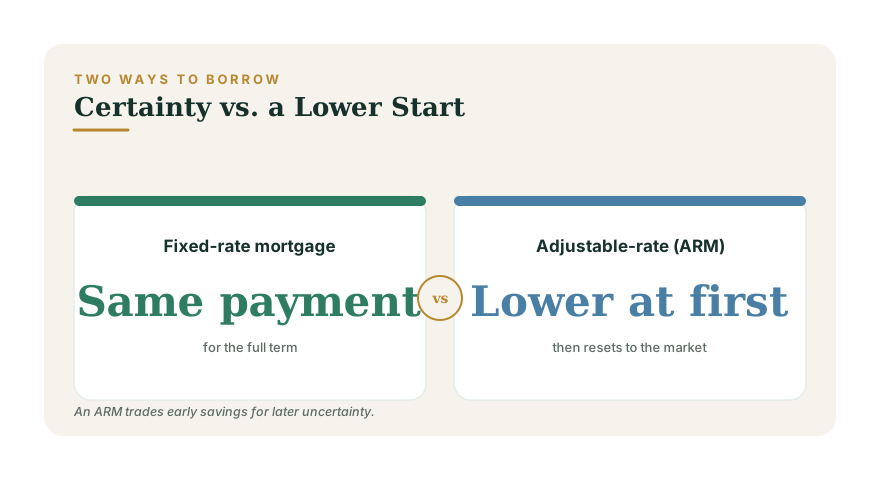
When you take out a mortgage, you face a fork in the road that shapes your payment for years: a fixed rate that never changes, or an adjustable rate that starts lower but can move. Most buyers default to fixed without much thought, and for good reason. But an adjustable-rate mortgage, or ARM, is a legitimate tool that can save real money, if you understand exactly what you are signing.
The Fixed-Rate Mortgage: Certainty
A fixed-rate loan does exactly what it sounds like. Your interest rate, and therefore your principal-and-interest payment, stays identical for the entire term, whether 15 or 30 years. Rates could double across the economy and your payment would not budge. You are paying a small premium for that predictability, but you get something valuable: a housing cost you can count on for decades, immune to interest-rate swings.
How ARMs Actually Work
An ARM has two phases. For an initial period, the rate is fixed, usually lower than a comparable fixed-rate loan. After that, it adjusts periodically based on market rates. You will see ARMs written as numbers like 5/1 or 7/1:
- The first number is the years the rate stays fixed. A 7/1 ARM is fixed for seven years.
- The second number is how often it adjusts afterward. A "1" means once per year.
When the rate adjusts, it is set by adding a fixed margin to a published index that tracks broader interest rates. Index plus margin equals your new rate. The margin never changes; the index does, which is the source of the uncertainty.
The Caps That Limit the Damage
ARMs are not unlimited gambles. They come with rate caps that restrict how much the rate can move, usually expressed as three numbers such as 2/2/5:
- The first is the maximum increase at the first adjustment.
- The second is the maximum increase at each subsequent adjustment.
- The third is the lifetime cap, the most the rate can ever rise above the starting rate.
Before you accept any ARM, calculate the worst case: take your start rate, add the lifetime cap, and figure out what that payment would be. If that maximum payment would break your budget, the ARM is too risky for you, full stop.
When an ARM Makes Sense
An ARM is a bet that you will not be exposed to the adjustable period for long, or that you can absorb it if you are. It tends to make sense when:
- You expect to move or sell before the fixed period ends. If you are confident you will be gone within seven years, a 7/1 ARM lets you pocket the lower rate and leave before it ever adjusts.
- You plan to pay the loan off quickly, for example with an expected windfall or aggressive prepayment.
- Fixed rates are unusually high and you have a credible plan to refinance later.
- You have the income and reserves to comfortably handle the maximum possible payment even if your plans change.
The Refinance Risk
Many ARM borrowers tell themselves, "I will just refinance before it adjusts." Sometimes that works. Sometimes it does not. Refinancing depends on rates being favorable, your credit and income still qualifying, and your home appraising well enough. If rates have risen, your finances have changed, or values have fallen, you may be stuck with the adjustment you were counting on avoiding. Treat "I will refinance" as a hope, not a guarantee, and make sure you could survive the loan if you never refinance. For the full picture on when refinancing is and is not worth it, see our guide on when to refinance your mortgage.
Comparing the Real Cost
Do not compare an ARM to a fixed loan on the starting rate alone, that is the trap. Instead:
- Estimate how long you will realistically keep the loan.
- Calculate total interest paid over that horizon for both options, using the ARM's start rate during the fixed period and a reasonable assumption for the adjustable years.
- Stress-test the ARM at its lifetime cap to see the true downside.
If you are confident you will be gone before the ARM adjusts, the lower start rate can win cleanly. If you might stay, the certainty of a fixed rate is usually worth its modest premium.
The Bottom Line
Fixed-rate loans buy peace of mind; ARMs buy a lower starting cost in exchange for accepting risk you must be able to handle. Neither is universally smarter. Match the loan to how long you will keep it and how much payment uncertainty you can truly absorb. Before you commit, run both scenarios against your budget and timeline using our tools.