Flexible Spending Accounts and Health Savings Accounts both let you pay for medical costs with pre-tax dollars, so people assume they are interchangeable. They are not. One is essentially a short-term discount on planned spending; the other is a long-term, portable investment account.
Picking the wrong one, or misusing the one you have, can cost you money you simply forfeit at year-end.
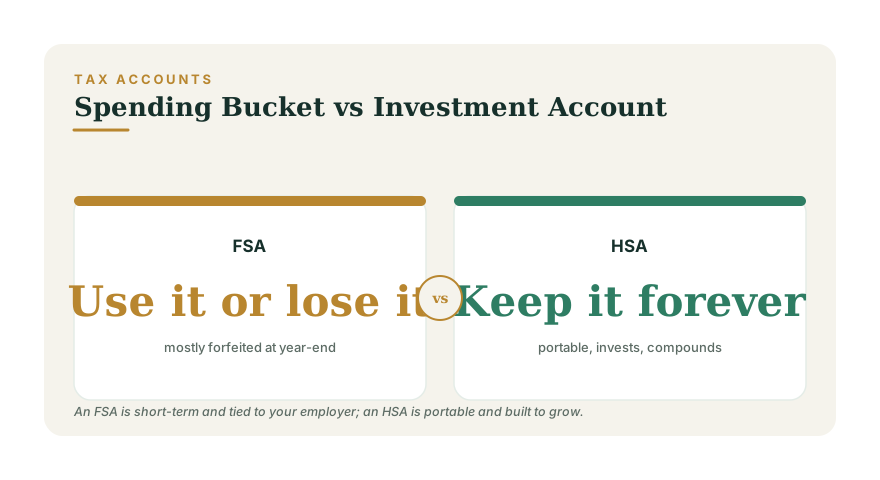
The fundamental difference
- HSA: you own it, it is yours for life, it moves with you between jobs, the balance rolls over indefinitely, and you can invest it.
- FSA: your employer owns the arrangement, it is generally tied to that job, and most of the balance is "use it or lose it" by year-end.
That single distinction drives almost every other decision.
Eligibility is not the same
An HSA requires that you be enrolled in a qualifying high-deductible health plan. An FSA does not require an HDHP and can pair with most employer plans, which is why many people on traditional PPO plans use an FSA instead. The annual contribution limits for each are set separately and adjusted by the IRS over time. Importantly, you generally cannot contribute to a standard HSA and a standard general-purpose FSA at the same time.
Use-it-or-lose-it: the FSA catch
FSA money is meant to be spent within the plan year. Some employers offer a short grace period or allow a limited amount to carry over, but anything beyond that is forfeited. That forces you to estimate your spending in advance, which is hard. Underestimate and you missed savings; overestimate and you scramble in December buying supplies just to avoid losing the money.
Because of this, an FSA works best for predictable, known costs: a planned procedure, regular prescriptions, ongoing therapy, or routine dental and vision care.
Limited-purpose FSA
There is a useful exception. If you have an HSA, you cannot also have a general FSA, but you can pair the HSA with a limited-purpose FSA. This narrower account covers only dental and vision expenses. Used together, the limited-purpose FSA pays current dental and vision bills while your HSA balance stays invested and untouched. It is a way to get the best of both.
Dependent-care FSA
A dependent-care FSA is a separate animal entirely. It is not for medical costs at all; it covers childcare, day camp, or care for a dependent adult so you can work. It has its own contribution limit and its own use-it-or-lose-it rule. If you pay for daycare, this can be one of the more valuable benefits your employer offers, since it shields a meaningful chunk of childcare spending from tax.
How to choose
- On an HDHP and able to save? Prioritize the HSA. It is the only one that builds long-term, tax-free wealth.
- On a traditional plan with steady medical costs? A health FSA captures pre-tax savings on spending you would do anyway.
- Have an HSA but ongoing dental or vision bills? Add a limited-purpose FSA.
- Paying for childcare? The dependent-care FSA is worth a hard look.
If you qualify for an HSA, learn why it can double as a stealth retirement account in our deeper guide to the HSA triple tax advantage.