Open enrollment forces a choice most people make on autopilot: pick the plan with the lowest premium, or pick the one with the lowest deductible. Both instincts can be wrong. The right answer depends on how much care you expect to use and whether you value the tax-advantaged savings an HSA makes possible.
What actually differs
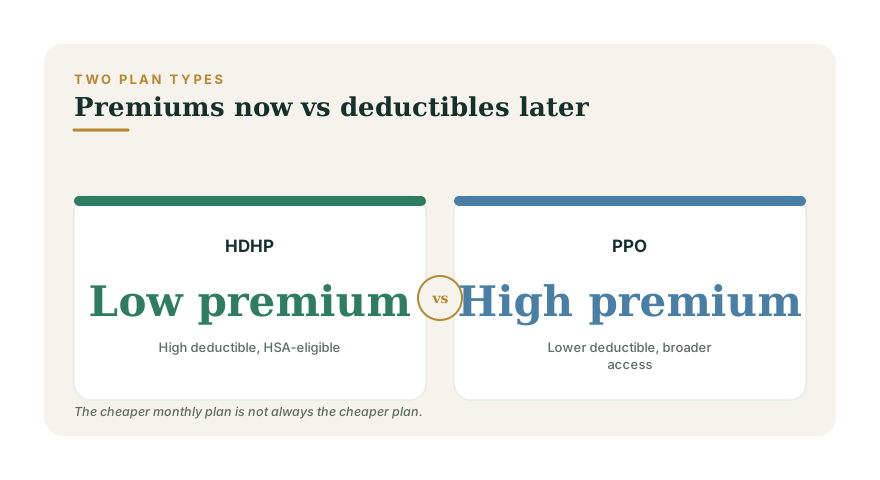
A high-deductible health plan (HDHP) trades a lower monthly premium for a higher deductible, meaning you pay more out of pocket before coverage kicks in. A PPO charges more each month but starts sharing costs sooner and usually offers a broader network with fewer referral requirements. The key features to compare:
- Premium — what you pay every month no matter what.
- Deductible — what you pay before the plan starts covering most services.
- Out-of-pocket maximum — the ceiling on your total spending in a year, which matters most in a bad year.
- Network rules — whether out-of-network care is partly covered or not at all.
The HSA factor
Only an HDHP lets you contribute to a Health Savings Account, and that is the quiet advantage that tips many decisions. HSA money goes in pre-tax, grows tax-free, and comes out tax-free for medical costs. Unused balances roll over forever and can be invested. If your employer contributes to your HSA, that contribution effectively offsets part of the higher deductible. We cover the mechanics in the HSA triple tax advantage.
Total-cost math by usage level
Do not compare premiums alone. Add up roughly what each plan would cost you across a realistic year:
- Low users (a checkup or two): the HDHP usually wins because you rarely touch the deductible and you bank the premium savings in an HSA.
- Moderate users (a chronic prescription, occasional visits): it gets close; run both scenarios with your actual costs.
- Heavy users (surgery, ongoing treatment, a planned birth): the PPO often costs less overall because lower deductibles and copays cushion a high-spending year.
A useful shortcut: compare the worst case. Take each plan's annual premium plus its out-of-pocket maximum. That tells you the most a single year could cost under each option, which is what protects you if something serious happens.
Network and access
If you have established doctors, confirm they are in-network for whichever plan you consider; an out-of-network specialist can erase any premium savings. HDHPs and PPOs both come in narrow and broad network versions, so read the directory rather than assuming.
Who each suits
The HDHP-plus-HSA combination tends to fit healthy people, savers who will actually fund and invest the account, and anyone whose employer chips in. The PPO tends to fit families with predictable high spending, people managing chronic conditions, and those who want maximum flexibility without referral hoops. Neither is universally better. Build your own numbers and revisit them when your health or family situation changes. To pressure-test how much coverage you really need across your whole plan, try the insurance calculator.