Ask around and you will hear it constantly: "I turned down a raise because it would bump me into the next tax bracket." It is one of the most expensive misunderstandings in personal finance, because it is completely false. A raise can never leave you with less money after taxes.
The confusion comes from treating tax brackets as if they apply to your entire income. They do not. They apply in layers.
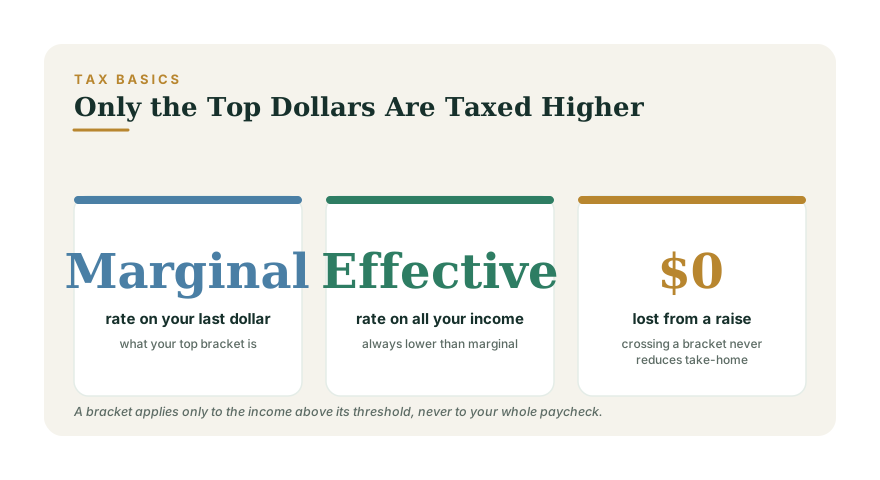
Marginal vs effective rate
Two terms unlock the whole thing:
- Marginal rate: the rate applied to your next dollar of income. This is the bracket people obsess over.
- Effective rate: the total tax you owe divided by your total income. This is your real, blended rate, and it is always lower than your marginal rate.
When someone says they are "in the 24% bracket," that 24% applies only to the income inside that band, not to everything they earned.
Income is taxed in layers
Picture your income flowing into a series of buckets stacked from low to high. The first bucket is taxed at the lowest rate. Once it fills, the next dollars spill into the next bucket and are taxed at the next rate, and so on. A bracket increase only ever applies to the dollars above that bracket's threshold. The dollars below it keep their lower rates.
So crossing into a higher bracket raises the tax on a small slice of new income, never on the income you already had.
A worked example
Imagine a simplified system with these rates: 10% on the first $10,000, 20% on income from $10,000 to $40,000, and 30% above $40,000. Suppose you earn $39,000 and get a $2,000 raise to $41,000, crossing into the 30% band.
- The first $10,000 is taxed at 10% the entire time.
- Income from $10,000 to $40,000 is taxed at 20% the entire time.
- Only the final $1,000 (the part above $40,000) is taxed at 30%.
That last $1,000 costs you $300 in tax, leaving $700. The other $1,000 of the raise is taxed at 20%, leaving $800. You take home an extra $1,500 from a $2,000 raise. You are unambiguously better off. There is no version of crossing a bracket where more gross income produces less net income.
Where the myth comes from
The myth survives because a few real things genuinely create "cliffs," and people lump them in with brackets:
- Some benefits or subsidies phase out at hard income thresholds.
- Certain credits shrink as income rises.
- A large one-time bonus can be over-withheld, making a paycheck look smaller until you reconcile at filing.
These are real, but they are not how ordinary tax brackets work, and they are the exception, not the rule.
Why this matters
Believing the myth leads to genuinely bad decisions: turning down raises, declining overtime, or avoiding a Roth conversion out of bracket fear. Once you internalize that only the top slice is taxed at the top rate, those decisions get much clearer. Take the raise. Then decide how to use the extra money wisely; start with the basics at /learn/articles.