Your home insurance deductible is the amount you pay out of pocket before the insurer pays anything. It is one of the few knobs you fully control on your policy, and turning it up lowers your premium. That sounds like an easy win, and the standard advice is to "raise your deductible to save money." But a deductible you cannot actually afford to pay is not a saving, it is a trap that springs at the worst possible moment.
The honest truth: the deductible is a risk you are keeping
When you raise your deductible, you are not eliminating risk, you are buying it back from the insurer in exchange for a lower premium. That is often a smart trade, because insurance should be reserved for the disasters that would wreck you financially, not for small, affordable repairs. The catch is simple: the higher deductible only saves you money if, on the day a tree comes through your roof, you can write the check without going into debt. If you cannot, the lower premium you enjoyed for years evaporates the first time you actually need the policy.
Follow the money
Insurers love higher deductibles for two reasons. First, you absorb the small and mid-size claims yourself, which are the frequent, expensive-to-process ones. Second, a higher deductible discourages you from filing at all, and insurers track and price on your claims history. Here is the part that catches people: filing small claims can raise your future premiums or even get your policy non-renewed, sometimes for years. So the insurer benefits whether you keep a low deductible (more premium) or a high one (fewer claims), while you carry the consequences of every filing decision. The system quietly trains you to use the policy as little as possible, which is fine, as long as you set it up so that using it rarely also means using it only for true emergencies.
Now the math
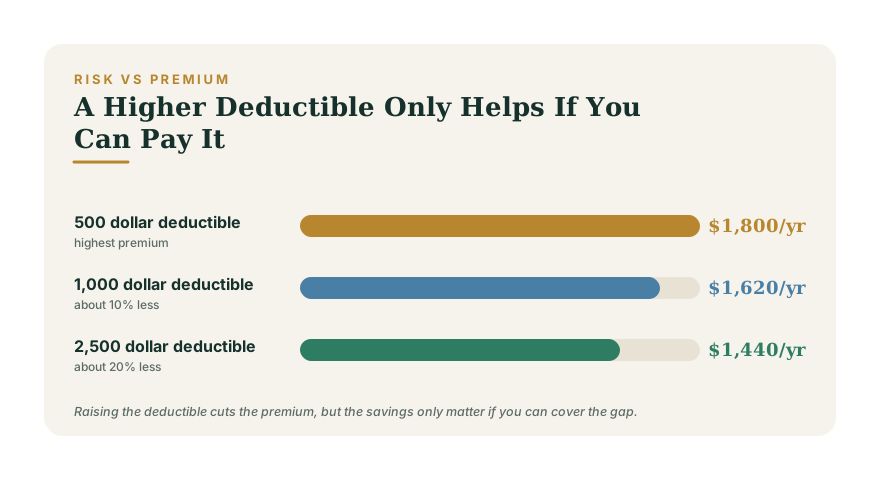
Premiums and savings vary by home and region, but the shape is consistent. Say your policy looks like this:
- 500 dollar deductible: 1,800 dollars a year.
- 1,000 dollar deductible: about 1,620 dollars a year, saving 180.
- 2,500 dollar deductible: about 1,440 dollars a year, saving 360.
Moving from a 500 to a 2,500 dollar deductible saves roughly 360 dollars a year. But you took on 2,000 dollars of extra risk. It takes about five and a half years of premium savings to cover that extra 2,000 dollars the first time you have a claim. If you go years without a claim, the higher deductible clearly wins. If you file in year two, it does not. The right answer depends on whether you have the cash to cover the gap and whether you have the discipline to only file for the big stuff.
Watch the percentage-based deductibles
Here is a trap that surprises homeowners after a storm. Many policies, especially in regions prone to hurricanes, wind, or hail, apply a separate percentage-based deductible for those perils, often 1% to 5% of your home's insured value rather than a flat dollar amount. On a home insured for 400,000 dollars, a 2% wind and hail deductible is 8,000 dollars, not the 1,000 dollar deductible you thought you had. People discover this only after the roof is gone. Read your declarations page and find every deductible, not just the headline one.
How to protect yourself
- Tie the deductible to your emergency fund. Set it no higher than an amount you could pay today, comfortably, without borrowing. If your emergency fund can absorb 2,500 dollars, a 2,500 dollar deductible is reasonable.
- Capture the savings, do not spend them. Take the premium you save from a higher deductible and add it to the emergency fund that backs the deductible. The strategy only works if the cash is actually there.
- Find your percentage-based deductibles. Check your declarations page for separate wind, hail, hurricane, or earthquake deductibles and translate the percentage into real dollars.
- Only file large claims. Pay small repairs yourself. A 1,200 dollar claim that triggers years of higher premiums or a non-renewal is a bad trade. Reserve the policy for losses that would actually hurt.
- Re-check after your home value changes. A percentage deductible grows automatically as your insured value rises, so revisit it when you increase coverage.
The honest recommendation
Set your deductible to the largest amount your emergency fund can cover without flinching, and not a dollar more. That maximizes your premium savings while guaranteeing you can actually pay the deductible when something goes wrong. Then bank the savings into that same emergency fund, hunt down any percentage-based deductibles hiding in your policy, and treat your insurance as protection against catastrophe, not a maintenance plan for small repairs.
The deductible decision is really a question about how much risk your savings can shoulder. Check your emergency fund, run the trade-off through the insurance calculator, and use the broader tools and your scores to make sure your deductible and your cash cushion are set to the same number.