Most people who know they should leave their financial advisor do not, and the reason is rarely the money. It is the awkwardness. You feel rude, you feel like the years you have already paid would be wasted, and the advisor is a perfectly nice person who once helped you. So you keep paying. That instinct is costing you, and the good news is that firing an advisor is far easier and far less personal than you fear.
The honest take: you do not owe your advisor loyalty for past service, and the sunk cost of fees you already paid is gone whether you stay or leave. The only question that matters is whether keeping them serves your future. If not, here is exactly how to walk away cleanly.
Why You Feel Trapped (And Why You Are Not)
Two psychological traps keep people stuck. The first is the sunk cost fallacy. You think, "I have paid this person for eight years, leaving now wastes all that." But the fees are already spent. Staying another year does not recover them. It only adds a ninth year of cost.
The second is simple politeness. We are wired to avoid confrontation, especially with someone we have a personal rapport with. But this is a business relationship you are paying for, and ending it is no more an insult than switching banks. The industry quietly relies on this discomfort. Inertia and guilt keep assets in place far longer than performance ever would.
The Step-by-Step Process
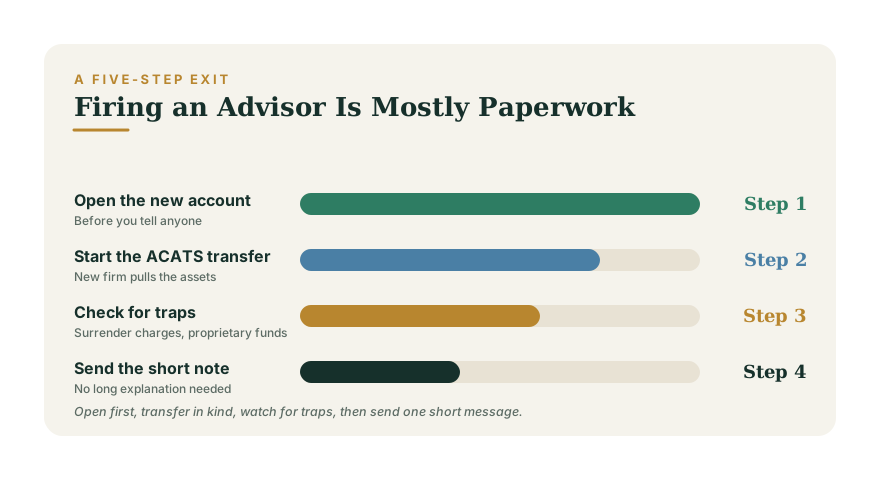
Step 1: Open the new account first. Before you say a word to your current advisor, open the destination account. That might be a low-cost robo-advisor, a self-directed brokerage account at a major custodian, or an account with a new fee-only fiduciary. You want the landing spot ready before you leave the plane. Do not liquidate anything yet.
Step 2: Use an in-kind ACATS transfer. The Automated Customer Account Transfer Service, or ACATS, lets your new firm pull your assets directly from the old one, usually in about a week or two. Critically, request an in-kind transfer, which moves your securities as-is without selling them. This is the single most important step for avoiding an accidental tax bill. You initiate this at the new firm, not the old one. You do not even have to call your old advisor to start it.
Step 3: Check for the traps before you transfer. This is where people get hurt. Before initiating, look for:
- Surrender charges. Annuities and some insurance-linked products carry surrender penalties that can run several percent if you exit within a set number of years. Find out the schedule before acting. Sometimes waiting a few months saves thousands.
- Proprietary funds that will not transfer in kind. Some firms put you in house-brand funds that another custodian cannot hold. Those must be sold to move, which can trigger capital gains. Identify these in advance.
- Capital gains timing. In a taxable account, selling appreciated positions creates a tax bill. In-kind transfers avoid this; forced liquidations do not. Where a sale is unavoidable, time it deliberately, and consider whether spreading sales across two tax years helps.
- Account closing or transfer-out fees. Many firms charge 50 to 125 dollars to transfer out. Annoying, but rarely a reason to stay. The new firm sometimes reimburses it.
Step 4: Send a short, professional message. You do not owe a speech, an argument, or a justification. A clean note is enough: "Thank you for your help over the years. I have decided to move my accounts to another firm. The transfer is being handled through my new custodian, so no action is needed on your end. I appreciate your time." That is it. Resist the urge to debate or explain. You are not asking permission.
Step 5: Confirm everything landed. Once the ACATS transfer completes, verify that all positions, cost basis, and any beneficiaries moved over correctly. Update any automatic contributions, and confirm cost basis transferred so future tax reporting is accurate.
Your Switching Checklist
- Open the new account before notifying your current advisor.
- Request an in-kind ACATS transfer to avoid selling and triggering taxes.
- Check for surrender charges on annuities or insurance products, and note the schedule.
- Identify any proprietary funds that cannot transfer and must be sold.
- Plan the tax timing of any unavoidable sales in taxable accounts.
- Send a brief, polite message. No explanation required.
- Verify all positions, cost basis, and beneficiaries arrived correctly, then redirect contributions.
An Honest Recommendation
Before you fire anyone, decide where you are going, because "anywhere but here" is not a plan. For most people leaving a high-fee advisor, the destination is simple: a low-cost robo-advisor for hands-off management, a self-directed account holding a few index funds, or a fee-only fiduciary charging a flat or hourly rate. Any of these typically slashes your all-in cost from around 1.5 to 2 percent down toward 0.25 percent or less, which over decades is the real reason to leave in the first place.
Do not let guilt subsidize an account that is quietly draining your wealth. Map out your destination portfolio and your future costs in your plan, run the fee comparison with our free wealth simulator, and check your scores once the dust settles. Firing an advisor is mostly paperwork. The hardest part is giving yourself permission, and the math gives you plenty of that.