A regular bond promises you fixed dollars. The problem is that fixed dollars buy less every year as prices rise. A 4 percent bond in a 5 percent inflation year is quietly losing your purchasing power even while it "pays" you. The U.S. government issues two instruments designed to solve exactly this — Series I savings bonds and Treasury Inflation-Protected Securities (TIPS). They are not the same thing, and confusing them leads people to use the wrong tool. If you want the basics of how ordinary bonds work first, start with bonds explained for beginners.
How I bonds work
An I bond's interest rate has two parts added together: a fixed rate set when you buy it (which stays for the life of the bond) and a variable inflation rate that resets every six months based on the consumer price index. When inflation runs hot, the variable piece climbs and your I bond keeps pace; when inflation cools, it drops, but the rate can never go below zero, so you do not lose principal to deflation.
The catches are real and worth knowing up front:
- You buy them directly from the government's TreasuryDirect website, not through a brokerage.
- There is an annual purchase limit — roughly 10,000 dollars per person per year electronically — so you cannot park a fortune here.
- You cannot touch the money for one full year, period.
- If you cash out before five years, you forfeit the last three months of interest. After five years there is no penalty.
- Interest is exempt from state and local tax, and federal tax is deferred until you cash out.
That profile makes I bonds excellent for medium-term savings — money you will not need for at least a year but want protected from inflation, like a portion of an emergency fund's second tier or a house down payment a few years out.
How TIPS work
TIPS take a different approach. Instead of adjusting the interest rate, they adjust the principal itself. As inflation rises, the face value of the bond increases; the coupon rate is fixed, but because it is paid on a growing principal, your actual interest payments rise too. At maturity you receive the inflation-adjusted principal (or the original, if there was net deflation).
Unlike I bonds, TIPS are real marketable securities:
- You can buy them in any amount through a brokerage, including via low-cost TIPS funds and ETFs.
- There is no purchase limit and no lockup — you can sell anytime on the open market.
- Because they trade, their price moves with interest rates, so a TIPS fund can show paper losses when rates rise, just like any bond fund.
- The inflation adjustment to principal is taxable each year even though you do not receive it until maturity — the so-called "phantom income" problem — which is why TIPS are usually best held in a tax-advantaged account.
When to use which
Think of them by job, not by which has the higher headline rate:
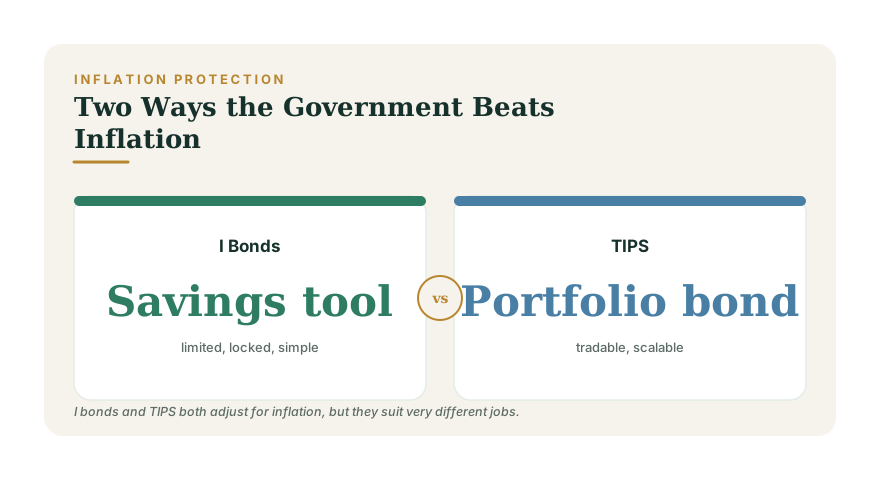
- I bonds are a personal savings tool. Use them for a capped amount of safe, inflation-protected cash you can leave alone for at least a year — a hands-off, no-fee, principal-safe holding.
- TIPS are a portfolio building block. Use them, typically through a fund inside an IRA or 401(k), when you want a meaningful, scalable allocation of inflation-protected bonds as part of your fixed-income mix.
Neither is a growth engine. They are defense — a way to make sure the conservative slice of your money does not silently erode. How big that slice should be depends on your age and timeline; see /learn/articles/asset-allocation-by-age.