If a financial professional sat you down and pitched a life insurance policy as an "investment," a "forced savings plan," or a way to "be your own bank," your guard should go straight up. What they are almost certainly selling is permanent life insurance: whole life, universal life, or indexed universal life. These products are pushed harder than almost anything else in personal finance, and the reason has very little to do with whether they are good for you.
The honest truth: insurance and investing should not be married
Life insurance exists to solve one problem: if you die, the people who depend on your income are taken care of. That is it. Term insurance does exactly that. You pay a fixed premium for a set number of years (say 20 or 30), and if you die during that window, your family gets the death benefit tax-free. It is cheap because it is simple, and because most people outlive the term.
Permanent life insurance staples that death benefit to a savings or investment account called "cash value," then charges you many times more. The pitch is that the cash value grows, you can borrow against it, and the coverage lasts your whole life. The reality is that the returns inside these policies are mediocre, the fees are buried and steep, and the flexibility is far worse than just owning insurance and investments separately.
Follow the money
Here is the part nobody pitching the policy will volunteer. The commission on a permanent life policy is often 50% to 100% of your entire first-year premium. If you sign up for a whole life policy costing 6,000 dollars a year, the agent can pocket several thousand dollars the moment the ink dries. A term policy on the same person might generate a commission of a few hundred dollars total.
That single fact explains the entire sales culture around these products. It explains why permanent life is described as an "investment" rather than insurance, why it is sold to young single people who have no dependents, and why the illustrations always show the rosiest possible growth. The product is not popular because it is good. It is sold aggressively because the payout to the seller is gigantic, and that commission comes out of your premium in the early years, which is exactly why the cash value barely moves for the first decade.
Now the math
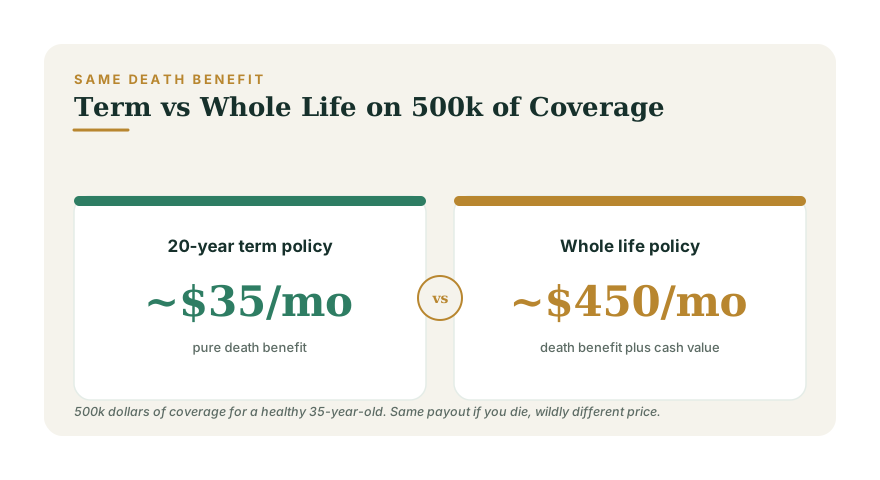
Take a healthy 35-year-old who needs 500,000 dollars of coverage.
- A 20-year term policy runs roughly 30 to 50 dollars a month, call it 35. Over 20 years that is about 8,400 dollars total for full coverage.
- A whole life policy for the same 500,000 dollars commonly runs 400 to 500 dollars a month, call it 450. That is 5,400 dollars a year, more than 12 times the term premium.
Now run the classic move: buy term and invest the difference. The whole life buyer spends 450 a month. The term buyer spends 35 a month for the same death benefit and invests the remaining 415 dollars a month in a low-cost index fund. At a 7% return, that 415 a month grows to roughly 216,000 dollars in 20 years and about 520,000 dollars in 30 years. The cash value inside a typical whole life policy over the same period, after its fees, usually lags a plain index fund by a wide margin, and you only get the cash value or the death benefit when you die, not both.
There is one more trap worth naming. If you cancel a permanent policy in the first several years, the "surrender value" you get back is often far less than what you paid in, because the front-loaded commission and fees came out first. Many people discover years later that they have been pouring money into a product they can barely exit without taking a loss.
How to protect yourself
The defense here is simple once you separate the two jobs the product is pretending to combine.
- Buy term to cover your actual need. Match the term length to how long people depend on your income, typically until the kids are grown or the mortgage is paid.
- Invest the difference yourself in a tax-advantaged account with low-cost index funds. You keep control, the fees are a fraction, and you can see exactly what you own.
- Be suspicious of any insurance sold as an investment. If the word "investment," "tax-free retirement," or "be your own bank" shows up in a life insurance pitch, that is a commission flag, not a benefit.
- Ask the agent directly what their commission is on each option. The answer, or their refusal to answer, tells you everything.
- Get independent term quotes from multiple insurers. Term is a commodity; the death benefit is identical, so you are just shopping for the lowest price on a strong company.
When permanent life actually makes sense
It is not literally never. There are narrow situations where permanent coverage is a legitimate tool:
- A large estate facing estate tax, where a permanent policy held in an irrevocable trust provides liquidity to pay the tax bill.
- A lifelong dependent, such as a child with special needs, who will need support after you are gone, often funded through a special-needs trust.
- A business needing a funded buy-sell agreement or key-person coverage that must last indefinitely.
- A high earner who has already maxed every tax-advantaged account and wants additional tax-deferred space, and even then only after running the numbers cold.
Notice that every one of these involves a permanent need or a specialized estate and tax problem, not "saving for retirement." If you are an ordinary household trying to protect your family and build wealth, none of them apply to you.
The honest recommendation
For the overwhelming majority of people, the right answer is buy term and invest the difference. Term insurance buys the exact same protection for your family at a fraction of the cost, and a low-cost index fund will almost certainly beat the cash value inside a permanent policy after fees. Keep your insurance and your investing in separate, transparent boxes that you control.
Figure out how much coverage you actually need before you talk to anyone selling a policy. Run your number through the insurance calculator, get a few independent term quotes, and use the broader tools and your scores to see how the money you save by skipping permanent life could compound for you instead of for an agent.