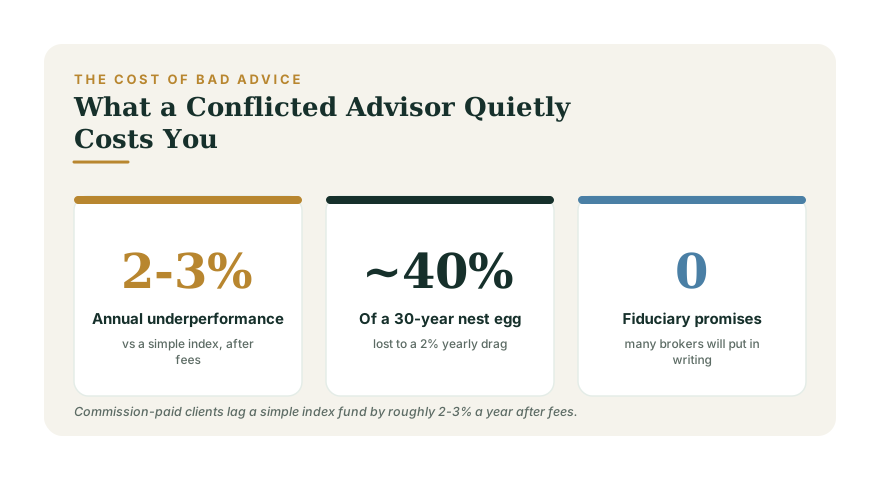
Your financial advisor is supposed to be on your side. For a large share of the industry, that is simply not how the paycheck works. Commission-based advisors and brokers get paid when you buy products, not when your portfolio grows, and the products that pay them the most are almost never the products that serve you best. The result is quiet and expensive: the average commission-based advisor's clients underperform a simple index fund by roughly 2-3% per year after fees. Over a few decades, that gap can erase a third or more of your final balance.
The good news is that bad advisors leave fingerprints. Once you know what to look for, the warning signs are hard to miss. Here are seven of them.
Follow the Money First
Before the red flags, understand the incentive. An advisor paid by commission earns money from the transaction. A mutual fund with a 5.75% front-end sales load hands the advisor thousands of dollars the moment you invest. An annuity can pay a 6-8% upfront commission. A plain Vanguard index fund pays the advisor nothing. When someone's income depends on selling you the expensive thing, the expensive thing tends to look very attractive to them - and the cheap, better thing rarely gets mentioned. That single fact explains almost every red flag below.
Red Flag 1: They Cannot Give You a Straight Answer About Pay
Ask one question: "Exactly how do you get paid, in dollars, on everything you recommend to me?" A trustworthy advisor answers plainly - an hourly rate, a flat fee, or a stated percentage of assets. A conflicted one gets vague. You will hear "the fund company compensates me" or "there's no cost to you" or "it's built into the product." There is always a cost. If they will not put the dollar figure in writing, assume it is large.
Red Flag 2: Hidden and Layered Fees
Look for fees stacked on top of fees. A common arrangement: a 1% advisory fee, wrapped around mutual funds that themselves charge 0.80% in expense ratios, some of which quietly kick back a 0.25% 12b-1 fee to the advisor. That is roughly 1.8% a year before you count trading costs. On a $250,000 portfolio that is $4,500 every year - whether your account goes up or down. Compare that to a 0.04% index fund costing $100 a year on the same balance.
Red Flag 3: High-Commission Products You Did Not Ask About
Be alert when the recommendation is a variable annuity, a non-traded REIT, a structured note, or an actively managed fund with a sales load. These are the highest-commission products in the business, and they are pitched far more often than they are genuinely needed. A 30-year-old in a stable job rarely needs a variable annuity. If one is on the table early in the conversation, ask who gets paid and how much.
Red Flag 4: Pressure to Trade or "Reposition"
If your statements show frequent buying and selling, or the advisor keeps calling with "an opportunity we need to act on today," be careful. For a commission earner, every trade is a payday. Excessive trading to generate commissions has a name - churning - and it is a violation of the rules, but it happens because the incentive rewards activity, not patience. Good long-term investing is mostly boring. Constant motion is a warning, not a sign of attentiveness.
Red Flag 5: Proprietary or "House" Funds
Some advisors work at firms that manufacture their own funds and reward employees for selling them. If every recommendation carries the same company's name, you are likely buying products chosen for the firm's revenue, not your return. Proprietary funds are frequently more expensive and no better - and they can be hard to move if you ever want to leave.
Red Flag 6: No Written Fiduciary Commitment
A fiduciary is legally required to act in your best interest. A broker operating under a lower standard only has to recommend something "suitable" - a much weaker bar that still allows the more expensive of two similar products. Ask your advisor to sign a simple statement confirming they act as a fiduciary on your entire relationship, at all times. A fee-only advisor signs without hesitation. Many brokers will not, because they legally cannot. Their refusal is your answer.
Red Flag 7: An Annuity Pushed Into Your IRA
This one is almost a tell. An annuity's main selling point is tax deferral - but an IRA is already tax-deferred. Putting an annuity inside an IRA layers on high fees and surrender charges to buy a tax benefit you already have. There are narrow exceptions, but most of the time, an annuity recommended for an IRA exists to generate a large commission. Treat it as a flashing light.
Your Pre-Meeting Checklist
Bring these questions to any advisor and watch how they respond. Hesitation is information.
- Are you a fiduciary 100% of the time? Will you put that in writing?
- Exactly how are you paid - in dollars - on every product you recommend?
- Do you ever earn commissions, 12b-1 fees, or revenue sharing? On what?
- What is the total annual cost of your plan: your fee plus fund expense ratios?
- Are any recommended funds proprietary to your firm?
- How often will you trade my account, and what triggers a trade?
- Can you show me a low-cost index alternative to each fund you recommend, side by side?
The Honest Recommendation
If your advisor fails these tests, you have better options that do not bury conflicts in fine print. A fee-only advisor - ideally one who charges a flat fee or by the hour and is a member of NAPFA - is paid only by you, so there is nothing to sell. For straightforward portfolios, a low-cost robo-advisor or a handful of Vanguard or similar index funds will beat most conflicted advisors after fees, with none of the games. You do not need to be wealthy to deserve advice that is actually on your side.
Run your own numbers before your next meeting. Use our fee-impact tools at /tools to see what your current setup is costing you over time, then walk in knowing exactly what good advice should look like.