Ask a traditional advisor why they charge 1 percent a year and you will hear about relationships, peace of mind, and personalized service. Those things can have real value. But the number itself, 1 percent versus the roughly 0.25 percent a robo-advisor charges, is not a rounding error. Compounded across a lifetime of investing, it is one of the largest single costs most people will ever pay, and almost nobody calculates it.
Here is the honest take: for the majority of investors with reasonably standard finances, a robo-advisor delivers nearly everything a typical human advisor does, at a quarter of the price, and the math makes the difference enormous.
What You Are Actually Paying For
Most mass-market human advisors charge an assets-under-management fee, usually around 1 percent per year. For that, the core services are: building a diversified portfolio, rebalancing it periodically, and sometimes harvesting tax losses. That is it for the day-to-day work.
A robo-advisor does all three of those things automatically, by software, for roughly 0.25 percent. It builds a portfolio out of low-cost index funds, rebalances it continuously without you asking, and runs automated tax-loss harvesting in taxable accounts. The robo never forgets, never goes on vacation, and never gets too busy with bigger clients to manage your account.
Follow the Money
The 1 percent AUM model is profitable precisely because it scales with your balance while the work does not. Managing a 2 million dollar portfolio is not ten times harder than managing a 200,000 dollar one, but it pays ten times more. That is why the industry fights so hard to keep the percentage-of-assets model alive and why it frames a robo as cold or impersonal. The framing protects the fee.
The Math That Settles It
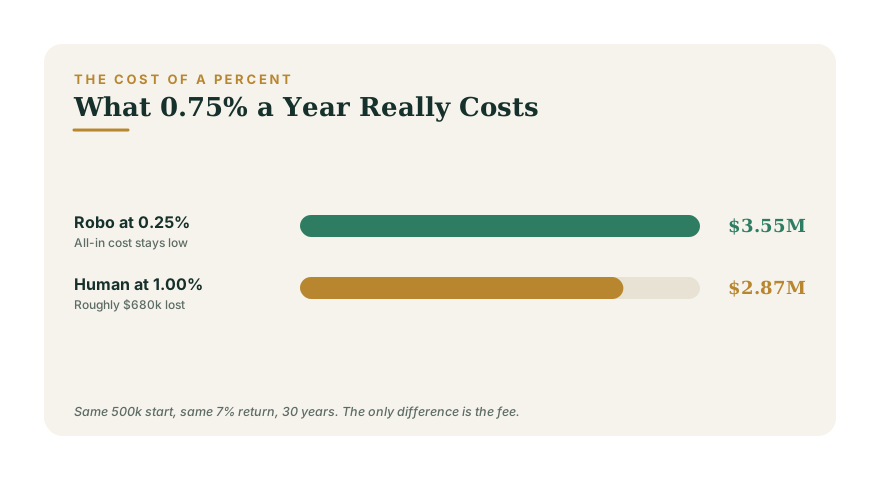
Take a 500,000 dollar portfolio earning a 7 percent gross annual return over 30 years, with no new contributions, so we can isolate the fee.
- At a 0.25 percent robo fee, your net return is about 6.75 percent. After 30 years you end with roughly 3.55 million dollars.
- At a 1.00 percent human advisor fee, your net return is about 6.00 percent. After 30 years you end with roughly 2.87 million dollars.
That 0.75 percent annual difference costs you around 680,000 dollars. Said another way, you would hand the advisor more than your entire starting balance over those three decades, purely in fee drag, for services a robo performs automatically. The fee is small. The compounding is not.
And this is the optimistic version. If your human advisor also steers you into actively managed funds with 0.7 percent expense ratios instead of 0.05 percent index funds, the gap widens further, because those funds, on average, also underperform.
When a Human Advisor Is Genuinely Worth It
This is where most robo-versus-human articles get dishonest by pretending one side has no value. A good human advisor absolutely earns their fee in specific situations:
- Complex tax and estate planning. Multi-state taxes, trusts, large estates, concentrated stock positions, equity compensation, and inheritance planning are genuinely hard. Software does not handle these well.
- Behavioral coaching during crashes. The single biggest destroyer of returns is panic selling at the bottom. An advisor who talks you off the ledge in March 2020 can save you more than their fee in one phone call. A robo cannot.
- Business owners and the self-employed. Solo 401(k)s, cash-balance plans, succession, and the tangle of personal and business finances reward real expertise.
- People who simply will not engage. If outsourcing the whole thing is the only way you will actually invest, paying 1 percent beats sitting in cash earning nothing.
Notice the pattern: a human is worth it for complexity and for managing your own behavior, not for the mechanical work of building and rebalancing a portfolio. If your finances are straightforward, you are paying a premium for services you do not need.
Your Decision Rule
- Add up your all-in cost: the advisory fee PLUS the expense ratios of every fund you hold PLUS any platform fees. Many people are stunned to find the real total is 1.5 to 2 percent.
- If your situation is straightforward and your true need is portfolio management, a robo at around 0.25 percent almost always wins on the math.
- If you face real complexity, concentrated stock, business ownership, or you know you panic in downturns, a fee-only fiduciary may earn their keep. Consider paying flat or hourly fees instead of a percentage of assets.
- If you do choose a human, demand the fiduciary standard in writing and insist on low-cost index funds inside the portfolio.
An Honest Recommendation
For most ordinary investors, a reputable low-cost robo-advisor, or a simple do-it-yourself portfolio of three or four index funds, will quietly beat the typical 1 percent human relationship over a lifetime. If you have genuine complexity, hire a fee-only fiduciary for advice and pay them hourly, while keeping your investments in low-cost funds. The goal is to pay for expertise where it exists and stop paying a percentage of your life savings for software-level work.
Before you sign or renew anything, calculate what you are really paying. Use our free wealth simulator to see how a fee difference compounds over your own time horizon, then map it into your plan. The number usually changes the decision.