A Roth conversion is simple in concept: you move money from a traditional IRA or 401(k), where it has never been taxed, into a Roth, where it will never be taxed again. The catch is that you pay ordinary income tax on every dollar you convert, in the year you convert it. Done in the right year, that is one of the smartest moves in the tax code. Done in the wrong year, you volunteer to pay a high tax rate on money you could have moved later for far less. The entire decision hinges on a single comparison: your tax rate today versus your tax rate when you would otherwise withdraw the money.
The honest truth: it is a bracket arbitrage, nothing more
Strip away the jargon and a conversion is a bet that your future tax rate will be higher than your current one. If you can pay 12% now to avoid paying 24% later, you win. If you pay 24% now on money you could have withdrawn at 12% later, you lose. There is no magic. The skill is recognizing the windows where your rate is temporarily low and converting just enough to fill the cheap brackets without spilling into the expensive ones.
When it makes sense: the low-income windows
The best opportunities cluster in years when your taxable income dips:
- Gap years. A sabbatical, a layoff, a year of graduate school, or starting a business that has not turned a profit yet can all push you into a low bracket temporarily.
- Early retirement before Social Security and RMDs. This is the sweet spot. If you retire at 62 but do not claim Social Security or take required minimum distributions until your 70s, you may have several years of very low taxable income. Filling those years' low brackets with conversions can dramatically shrink the RMDs that would otherwise be taxed at a higher rate later.
- Down-market years. If your IRA balance has fallen, converting lets you move more shares for the same tax bill, and the recovery happens inside the Roth tax-free.
Now the math
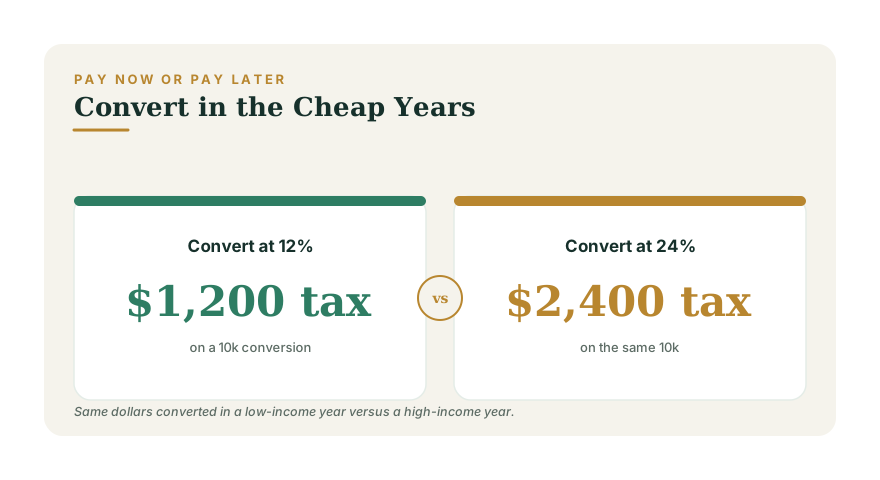
Say you are in an early-retirement gap year. Your taxable income is low enough that you have room left in the 12% bracket before crossing into the next one up. You convert 10,000 dollars and pay about 1,200 dollars in tax. Compare that to converting the same 10,000 dollars during your working years at a 24% rate, which would cost 2,400 dollars. Same money moved, double the tax, just because of when you did it. Stretch that over several gap years and a strategy of filling the 10% and 12% brackets each year can move six figures into a Roth at a blended rate most people would be thrilled to pay.
The rules that trip people up
- The pro-rata rule. If you have both pre-tax and after-tax money across all your traditional IRAs, you cannot cherry-pick the after-tax dollars to convert tax-free. The IRS treats your IRAs as one pool, so each conversion is a proportional mix of taxable and non-taxable money. This is what sinks careless backdoor-Roth attempts.
- The 5-year rule. Each conversion starts its own five-year clock. Withdraw the converted amount before five years and before age 59 and a half, and you can owe a penalty even though you already paid the income tax. Plan conversions well before you need the cash.
- Pay the tax from outside the IRA. If you use part of the converted money to cover the tax bill, you shrink the amount that gets to grow tax-free, and if you are under 59 and a half, the portion withheld can count as an early withdrawal. Always pay the conversion tax from a regular savings or taxable account.
- IRMAA and bracket bumps. A conversion adds to your income, which can push you into a higher bracket and, for those on Medicare, trigger IRMAA, the income-related surcharge on Part B and Part D premiums. It can also raise the taxable share of your Social Security. Convert too much in one year and these stealth costs eat your savings.
When NOT to convert
Skip or shrink the conversion if you are in a high bracket today and expect to be in a lower one in retirement, if you cannot pay the tax from outside the account, if the conversion would spike your income enough to trigger IRMAA or a big bracket jump, or if you are likely to need the money within five years. There is also little point converting late in retirement if your heirs are in a lower bracket than you, since they may inherit and withdraw it more cheaply than you can convert it.
Your decision checklist
- Estimate your current marginal bracket and your expected bracket in retirement. Convert only if today's is lower or equal.
- Identify how much room you have left in your current bracket before the next one, and size the conversion to fit inside it.
- Confirm you can pay the resulting tax from outside the IRA.
- Check the pro-rata exposure across all your traditional IRAs.
- If you are on Medicare or near it, model the IRMAA thresholds before converting.
- Spread large conversions across multiple low-income years rather than one big year.
- Verify current-year brackets, IRMAA tiers, and limits at IRS.gov, since they change annually.
The honest recommendation
Roth conversions are a multi-year project, not a one-time button. The biggest wins come from disciplined, partial conversions during the low-income years between retiring and the start of Social Security and RMDs, filling the cheap brackets and no more. Done that way, you trade a known, low tax bill now for decades of tax-free growth and smaller forced withdrawals later. Tax rules change, so confirm this year's figures before you act.
Because the right amount depends entirely on your bracket headroom and your timeline, model a few conversion sizes before you commit. Sketch it out in your plan, use our tools to see how it reshapes future withdrawals, and read more on the mechanics in our articles.