The most common Social Security decision is also one of the worst: a huge share of people claim the moment they turn 62, the earliest age allowed. It is understandable. The money is finally available, you have paid in your whole life, and there is a nagging fear the program will not be there later. But claiming at 62 permanently reduces your monthly check for the rest of your life, and for most people that early grab leaves a remarkable amount of money on the table. This is one of the few retirement levers that is fully in your control, and it deserves more than a gut decision.
The honest truth: the check changes a lot with timing
Your benefit is calculated from a figure called your primary insurance amount, payable in full at your full retirement age (67 for most people retiring now). Claim before that and the benefit is permanently cut; claim after and it permanently grows.
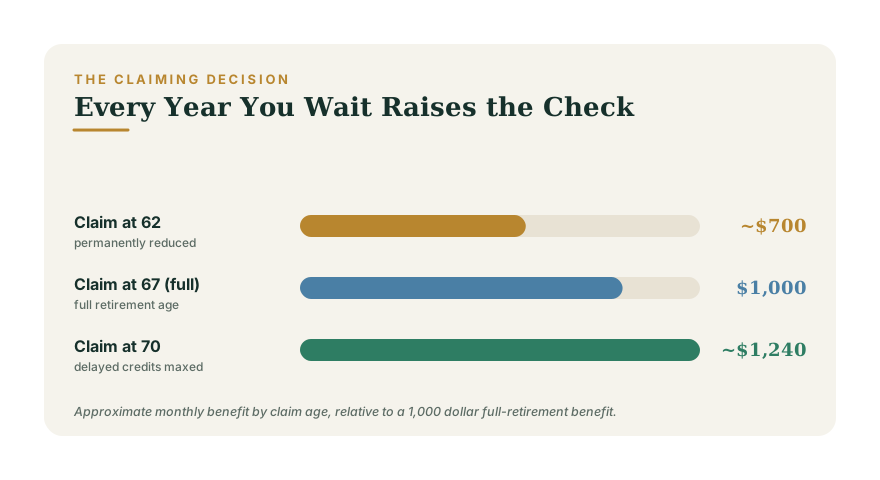
- Claim at 62 and you take roughly a 30% permanent cut versus your full benefit.
- Claim at 67 (full retirement age) and you get 100%.
- Delay past 67 and you earn delayed retirement credits of about 8% per year up to age 70, lifting your check to roughly 124% of full.
So the same person could receive about 700 dollars, 1,000 dollars, or 1,240 dollars a month for the identical work history, purely based on when they file. After 70 there is no further increase, so there is never a reason to wait beyond it.
The break-even analysis
Claiming early means more checks, but smaller ones. Claiming late means fewer checks, but bigger ones. The break-even is the age at which the larger delayed checks overtake the head start the early claimer banked. Comparing claiming at 62 versus 70, the crossover typically lands somewhere in the late seventies to around age 80, depending on assumptions. Put plainly: if you live past your early eighties, delaying wins, and the longer you live, the more it wins. If you die before then, claiming early came out ahead.
This reframes the whole decision. Social Security is not really an investment to optimize; it is longevity insurance. It is the one income stream that is inflation-adjusted and lasts as long as you do, no matter how long that is. Delaying buys you a bigger guaranteed, inflation-protected check precisely for the scenario you cannot afford to get wrong: living a very long time and running low on other money.
Longevity is the real variable
If you are in poor health or have a family history of short lifespans, claiming earlier is reasonable, because you may not reach the break-even age. But most people underestimate how long they will live. For a healthy 65-year-old, reaching the late eighties is common, and for couples, the odds that at least one spouse lives well into their nineties are high. Planning around an average lifespan can leave the long-lived in trouble, which is exactly the outcome delaying protects against.
Spousal and survivor benefits change the math for couples
For married couples, the decision is not two separate choices; it is a joint one. Two features dominate:
- Survivor benefits. When one spouse dies, the survivor keeps the larger of the two benefits, not both. This is the single most important fact in the whole decision. If the higher earner delays to 70, they lock in the biggest possible check, which then becomes the survivor's check, potentially for many years. Delaying by the higher earner protects whichever spouse lives longer.
- Spousal benefits. A lower-earning spouse can claim up to half of the higher earner's full-retirement benefit, which can make sense to claim earlier while the higher earner's own benefit grows in the background.
The common winning pattern: the lower earner claims earlier to start some income, while the higher earner delays as long as possible to maximize both the joint income and the eventual survivor benefit.
Watch the earnings test if you keep working
If you claim before full retirement age and are still working, the earnings test temporarily withholds part of your benefit once your wages exceed an annual limit. It is not truly lost (your benefit is recomputed and bumped up later at full retirement age), but it is a strong signal that claiming early while still earning a paycheck is usually the worst of both worlds.
When claiming early is the right call
- You have serious health issues or a family history suggesting a shorter lifespan.
- You need the income now and have no other reasonable source to bridge the gap.
- You are the lower earner in a couple and the strategy is for you to claim early while the higher earner delays.
- You are confident you can invest the early checks well and your longevity outlook is genuinely short.
The honest recommendation
For most healthy people, and almost always for the higher earner in a marriage, waiting pays, with age 70 being the sweet spot because the 8%-a-year delayed credits are a guaranteed, inflation-protected raise you cannot buy anywhere else. The biggest mistake is claiming at 62 by reflex without running your own break-even and, if you are married, coordinating with your spouse. This is a once-in-a-lifetime, irreversible-feeling decision; treat it that way.
Run your own break-even using your estimated benefit at different ages, and if you are a couple, model the higher earner delaying so the survivor is protected. You can stress-test how Social Security timing fits the rest of your income on the wealth simulator, fold it into your overall plan, or learn more in our articles library. The right claim age is the one your actual life, not a reflex, points to.