Every year you face one foundational choice on your tax return: take the standard deduction or itemize. Both reduce your taxable income, and you take whichever one is bigger. That is the entire decision in one sentence, but the details determine which side wins, and a few moves can shift the outcome in your favor.
Since a major tax law roughly doubled the standard deduction, the math now favors most filers taking the flat amount. But "most" is not "all," and knowing where you stand is worth the few minutes it takes.
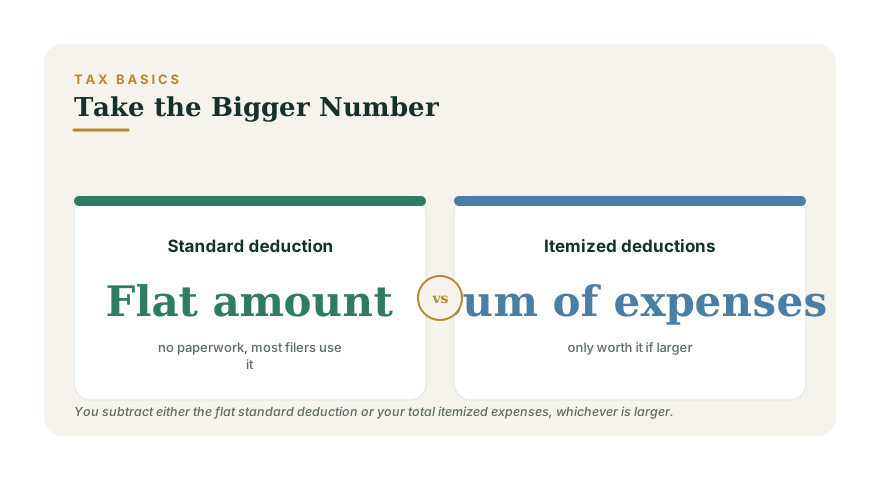
What each one is
- Standard deduction: a flat dollar amount, set by filing status and adjusted yearly by the IRS, that you subtract with zero documentation.
- Itemized deductions: the sum of specific qualifying expenses you list on Schedule A. You only benefit if that total exceeds the standard deduction.
You cannot do both, and you cannot mix and match. It is one or the other.
Common itemizable expenses
- State and local taxes (SALT): property taxes plus either state income or sales tax, but capped at a federal limit that has constrained high-tax-state filers.
- Mortgage interest: interest on home-acquisition debt up to a balance limit.
- Charitable contributions: cash and the fair value of donated goods to qualified organizations.
- Medical expenses: only the portion that exceeds a percentage-of-income threshold, so only large bills tend to count.
Add these up. If the total clears the standard deduction, itemizing wins. If not, take the standard.
Why most filers now take the standard deduction
Two changes pushed the majority toward the standard deduction. First, the standard amount itself jumped substantially. Second, the cap on SALT deductions shrank one of the largest line items many homeowners used to claim. Together they raised the bar for itemizing high enough that, for the typical filer, the flat amount is simply larger. That is good news: it means less paperwork and a simpler return for most people.
The bunching strategy
If your itemizable expenses fall just short of the standard deduction most years, you can still win by "bunching." The idea is to concentrate deductible expenses into a single year so you clear the threshold, then take the standard deduction in the off years.
- Make two years of charitable gifts in one calendar year, then skip the next.
- Use a donor-advised fund to make a large deductible contribution now while distributing to charities over time.
- Time elective medical procedures or property-tax payments where the rules allow.
Over a two-year cycle you get one big itemized year and one standard year, capturing more total deduction than taking the standard twice.
How to decide
- Tally your itemizable expenses for the year.
- Compare that total to your standard deduction.
- If close, ask whether bunching could push you over in alternating years.
- Take the larger result, and keep records for anything you itemize.
Most people will land on the standard deduction and be done. If you own a home in a high-tax area or give generously, run the numbers both ways. For more breaks worth checking, see our list of deductions people commonly miss.