Tax-loss harvesting sounds like a trick reserved for the wealthy, but the mechanics are plain enough for any beginner to use. The idea is this: when an investment in a regular taxable account drops below what you paid for it, you sell it to lock in the loss on paper, use that loss to cancel out taxable gains elsewhere, and immediately buy something similar so you stay invested. You end up owning roughly the same exposure to the market, but with a tax deduction you did not have before. Nothing about your long-term strategy changes. You just let a temporary dip do some tax work for you.
The honest truth: it only works in taxable accounts
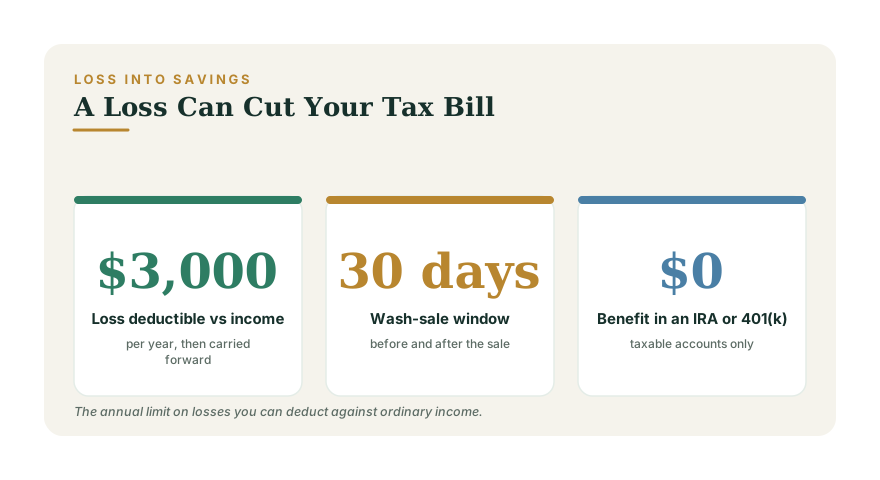
This is the first thing to get straight, because it eliminates the confusion right away. Harvesting losses does nothing inside an IRA, 401(k), or any other tax-sheltered account, because those accounts are not taxed on gains in the first place. There are no taxable gains to offset and no deduction to claim. Tax-loss harvesting is purely a tool for your taxable brokerage account. If everything you own is in retirement accounts, you can stop reading and feel fine about it.
How the offset actually works
The IRS lets your capital losses cancel your capital gains. The order matters a little: losses first offset gains of the same type (short-term against short-term, long-term against long-term), then any leftover loss offsets the other type. If your losses still exceed your gains after all that, you can deduct up to 3,000 dollars of the remaining loss against your ordinary income each year. Any loss beyond that does not disappear. It carries forward indefinitely to future years, offsetting future gains or another 3,000 dollars of income annually until it is used up.
Now the math
Suppose you sold a winning fund earlier in the year and booked a 5,000 dollar long-term gain. Later, a market dip leaves another holding 8,000 dollars underwater. You harvest that 8,000 dollar loss. First it wipes out the 5,000 dollar gain entirely, so you owe nothing on it. That leaves a 3,000 dollar loss, which you deduct against your ordinary income. If you are in the 22% bracket, that deduction is worth about 660 dollars off your tax bill. And because you bought a similar fund the same day, you never left the market, so when it recovers you capture the rebound. The loss was on paper; the tax savings are real.
The wash-sale rule, and how to stay invested
Here is the one rule that can blow the whole thing up. The wash-sale rule disallows your loss if you buy the same or a "substantially identical" security within 30 days before or after the sale, a 61-day window in total. The IRS will not let you claim a loss while keeping the exact same position. The fix is to buy something similar but not identical: sell an S&P 500 index fund and buy a total-market index fund, or swap one provider's large-cap fund for another's. You keep nearly the same market exposure without triggering the rule. After 31 days you can switch back if you want, though usually there is no need. Be careful that an automatic dividend reinvestment or a purchase in your IRA does not accidentally count as the repurchase.
Be honest about the size of the benefit
This is where the industry sometimes oversells. Harvesting does not make a losing investment a winner. In many cases it defers tax rather than eliminating it, because selling at a loss lowers your cost basis in the replacement, which can mean a larger taxable gain down the road. The real, durable benefits are the 3,000 dollar annual income deduction, the value of paying tax later instead of now, and the chance that you eventually pay at a lower rate or never (if the assets pass to heirs with a stepped-up basis). Those are worthwhile, but they are measured in hundreds of dollars a year for most people, not life-changing sums. Treat it as a sensible bonus, not a strategy worth contorting your portfolio over.
Your harvesting checklist
- Confirm the holding is in a taxable account. If it is in an IRA or 401(k), stop.
- Check that you actually have a loss versus your cost basis, not just a drop from a recent high.
- Line up a similar but not substantially identical replacement to buy the same day so you stay invested.
- Avoid buying that security (or having it auto-reinvest) anywhere, including your IRA, within 30 days on either side.
- Match short-term losses to short-term gains first to maximize the value, since short-term gains are taxed higher.
- Track your carryforward so you do not forget unused losses in future years.
- Confirm the current-year deduction limit and rules at IRS.gov before you file.
The honest recommendation
Harvest opportunistically, mainly during market downturns when losses are plentiful, and never let the tax tail wag the investment dog. Do not sell a holding you would otherwise keep just to chase a small deduction. If the bookkeeping feels like a chore, most robo-advisors automate tax-loss harvesting daily in their taxable accounts, which is one of the few features genuinely worth something. Just remember the benefit is modest, and tax rules change, so verify this year's limits before relying on them.
If you want to see how trimming your tax drag compounds over decades, run your taxable accounts through our tools, fold the habit into your plan, and read more on capital gains in our articles.