If a low-cost index fund from a company like Vanguard quietly beats most actively managed funds after fees, why does your advisor never seem to bring it up? The answer is not a mystery, and it is not about performance. It is about who gets paid. Vanguard's whole reason for existing is to charge as little as possible - and "as little as possible" means there is almost nothing left over to pay an advisor to sell it.
To see why the better product gets ignored, you have to follow the distribution economics that the industry rarely explains to clients.
How Fund Companies Pay for Shelf Space
Selling a fund costs money - marketing, brokerage relationships, and the advisors who recommend it. Most fund companies pay for that distribution out of the fees they charge you. There are three main channels:
- Sales loads. A front-end load (often up to 5.75%) is skimmed off your investment the moment you buy, and a chunk of it goes straight to the advisor who sold it.
- 12b-1 fees. An ongoing marketing-and-distribution fee baked into the fund's expense ratio - commonly 0.25% a year - that is paid out to the advisor and their firm year after year, for as long as you hold it.
- Revenue sharing. Behind-the-scenes payments from fund companies to brokerages to keep their funds on the "approved" or "preferred" list the advisor chooses from.
Vanguard is structured as a near-cost operation owned by its own funds. It does not pay meaningful sales loads, it minimizes or avoids 12b-1 fees, and it does not buy its way onto preferred lists. Translation: recommending Vanguard pays a commission advisor essentially nothing. A loaded active fund can pay them thousands up front plus a trailing slice every year. From inside that incentive, the expensive fund is the one that keeps the lights on.
The Math the Fees Are Hiding
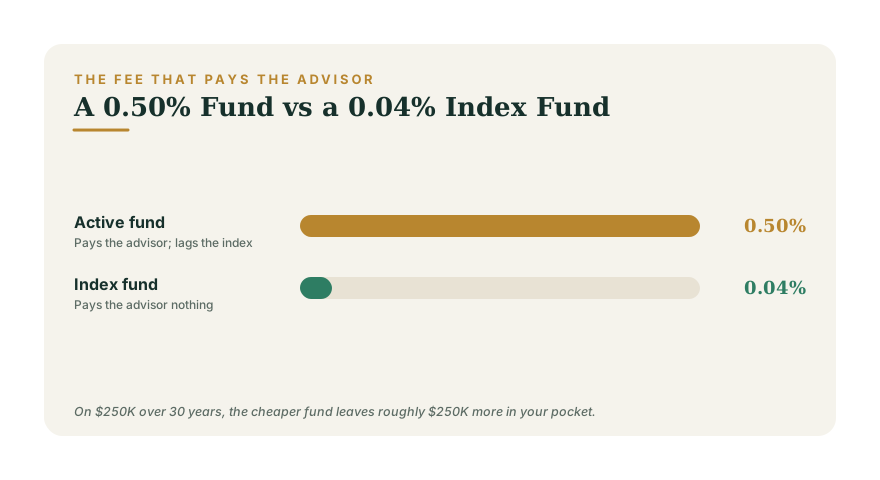
Fees sound trivial as percentages and are devastating as dollars, because they compound against you for decades. Compare two funds that hold similar stocks: an active fund at 0.50% and an index fund at 0.04% - a 0.46% yearly difference.
Put $250,000 in each and assume both earn 7% a year before fees for 30 years. The 0.04% index fund grows to roughly $1.88 million. The 0.50% fund grows to roughly $1.64 million. That 0.46% gap quietly cost you about $240,000 - not because the active fund's managers were incompetent, but because the fee was a permanent headwind compounding the entire time.
And 0.50% is generous. Plenty of loaded active funds charge 1.0% or more, and most still fail to beat their index after costs. Stretch the gap to a full percentage point and the lost amount runs into the high six figures on the same starting balance.
Why "It Is Built In" Is the Most Expensive Phrase in Finance
The reason these costs persist is that you never see a bill. A 12b-1 fee or an embedded expense ratio is subtracted inside the fund before the return is reported to you. There is no line item, no invoice, no monthly charge to notice and cancel. That invisibility is exactly why the high-fee channel survives and why a free, better alternative can go unmentioned for years. What you cannot see, you do not push back on.
How to Protect Yourself
- For every fund recommended to you, ask for its expense ratio and whether it carries a load or a 12b-1 fee.
- Ask point-blank: "How much do you get paid if I buy this, and how much if I buy a comparable index fund instead?"
- Request a side-by-side comparison against a low-cost index fund covering the same market.
- Total your real cost: advisory fee plus weighted fund expense ratios. Anything near or above 1.5% deserves hard scrutiny.
- Remember that low cost is the single most reliable predictor of long-term fund performance - one of the few things research agrees on.
The Honest Recommendation
This is not a commercial for one company. Vanguard simply happens to be the clearest example of a structure that puts cost on the investor's side - and Fidelity, Schwab, and iShares now offer index funds at comparably low expense ratios. If you want to keep an advisor, fine - but pay them directly through a fee-only arrangement so they have no reason to hide the cheap option from you. If your needs are simple, a robo-advisor or a do-it-yourself three-fund index portfolio captures nearly all the benefit with none of the conflict.
See the damage your current fees are doing before you change anything. Run your numbers through our wealth simulator at /tools and watch how a fraction of a percent reshapes your retirement.