Ask three people whether you need a living trust and you will get three confident, contradictory answers. The estate-planning industry has an incentive to sell trusts, while plenty of people manage perfectly well with a simple will. The honest answer depends on what you own, where you live, and what you want to control after you are gone.
Let us strip away the sales pitch and look at how each document actually works.
How a Will Works
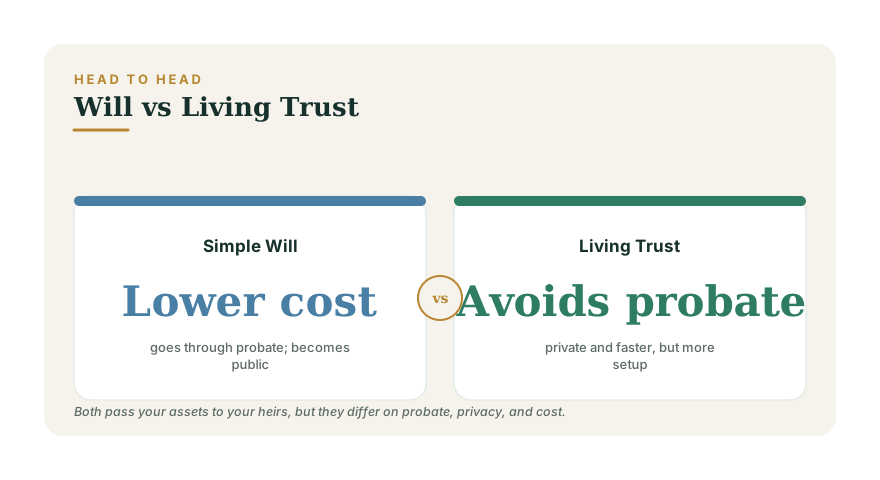
A will is a set of instructions that takes effect only after you die. It names who inherits your property, who serves as executor, and — crucially — who becomes guardian of your minor children. But a will does not move your assets on its own. It has to be validated and administered by a probate court, which oversees paying your debts and distributing what remains.
Probate is not the catastrophe some marketers claim, but it has real downsides: it takes months to over a year, it costs money in court and attorney fees, and it is a public record anyone can read. The upside is that a will is cheaper to create and simpler to maintain.
How a Living Trust Works
A revocable living trust is a legal container you create while alive. You transfer ownership of your assets into the trust and name yourself as trustee, so nothing about your day-to-day control changes. When you die, a successor trustee you chose distributes the assets directly to your beneficiaries — no probate court required.
That is the headline benefit: assets in a properly funded trust skip probate entirely. They pass privately, usually faster, and without court fees. A trust also functions if you become incapacitated, letting your successor trustee manage things without a court conservatorship.
The Catch With Trusts: Funding
A trust only avoids probate for the assets you actually transfer into it. This step — called funding the trust — is where most do-it-yourself plans fall apart. If you create a trust but never retitle your house, brokerage account, or bank accounts into its name, those assets still go through probate, and you paid for a trust that did nothing.
- Retitle real estate. Deed the property into the trust's name.
- Move financial accounts. Retitle non-retirement accounts to the trust.
- Use a pour-over will. A backup that sweeps any forgotten assets into the trust at death.
When a Trust Is Worth It
A living trust earns its cost in several common situations:
- You own real estate in more than one state. A will means probate in each state; a trust avoids the multiple proceedings.
- You value privacy. Trust distributions stay out of the public record.
- You want control over timing. Trusts can release money in stages — at certain ages or milestones — rather than all at once.
- You have a complex or blended family. Trusts handle nuance that a simple will cannot.
When a Trust Is Overkill
If your estate is modest, your assets already pass by beneficiary designation or joint ownership, and you live in a state with a streamlined small-estate or simplified probate process, a trust may add cost and complexity for little gain. Many younger people with a home, retirement accounts, and named beneficiaries are well served by a solid will plus up-to-date beneficiary forms.
The Practical Bottom Line
A trust is not a substitute for a will — most trust plans include a will too. Think of it as a layered decision: everyone needs a will, and some people add a trust to avoid probate, gain privacy, or control distributions. Match the tool to the problem you actually have, not the one a salesperson wants you to fear.
Before you decide, get clear on what you own and how it is titled. Our planning tools can help you take inventory, and you can keep reading about probate and beneficiaries in our article library.