Standard budgeting advice assumes a steady paycheck. You know roughly what arrives on the first and the fifteenth, so you plan against it. Freelancers, commission earners, gig workers, and small-business owners do not have that luxury. One month brings 8,000 dollars, the next brings 2,000, and the month after that a client pays sixty days late. Budgeting against an average that never actually shows up is how irregular earners end up broke in the lean months and loose in the fat ones.
Start with a bare-bones baseline
The foundation of an irregular-income budget is knowing your true survival number. Strip your spending down to what it costs to keep the lights on: housing, utilities, groceries, insurance, minimum debt payments, transportation, and basic necessities. This is your bare-bones budget, the amount you must cover even in a terrible month. Cut out everything discretionary to find it, then write it down as a hard floor.
Knowing this number changes how you feel about lean months. A slow month is only a crisis if it falls below your floor. If your bare-bones budget is 3,200 dollars and a quiet month still brings in 3,500, you are fine, even if it felt scary. The baseline replaces vague anxiety with a clear line.
Smooth the swings with a buffer account
The core technique for irregular income is to put a buffer between your earnings and your spending, so the lumps never reach your daily life. Here is how it works in practice. Every dollar you earn goes into a holding account, not your checking account. From that holding account, you pay yourself a fixed amount each month, your salary, and the rest stays in the buffer. In a strong month the buffer grows; in a weak month you still pay yourself the same salary, drawn from what the strong months stockpiled.
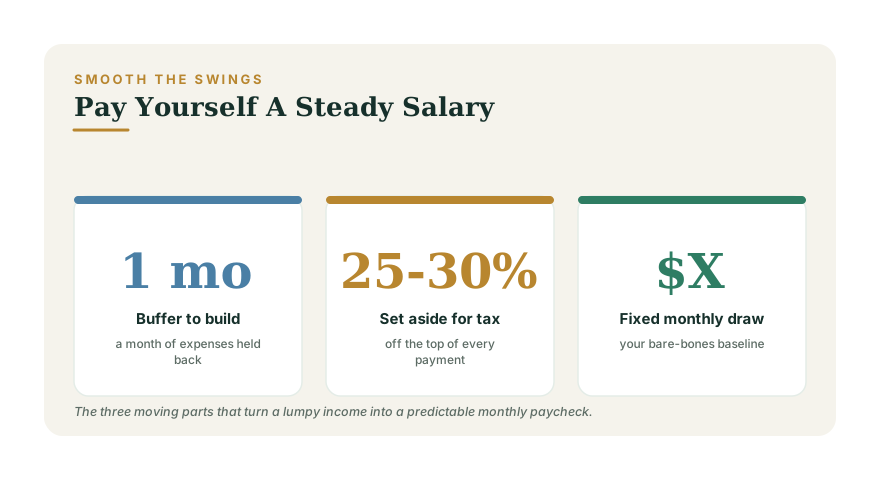
The goal is to build the buffer up to at least one month of expenses, ideally more, so you are always spending last month's money rather than this month's hope. Once the buffer holds a full month, you can budget like a salaried person, because functionally you have become one. The income still swings wildly; your spending does not.
Pay yourself a salary
Deciding your salary is the key judgment call. Set it conservatively, close to your bare-bones baseline plus a modest amount for the goals that matter most, not at the level of your best months. If you average roughly 6,000 dollars a month but your floor is 3,200, paying yourself 4,000 to 4,500 leaves room to fund the buffer, taxes, and savings while still feeling like a real paycheck.
When the buffer grows beyond a comfortable cushion, you can give yourself a raise or sweep the surplus into investing and longer-term goals. The discipline is in resisting the urge to spend a 10,000-dollar month as though every month will be a 10,000-dollar month. They will not.
Set aside taxes before anything else
No one withholds taxes for the self-employed, which means the full bill, including self-employment tax, is yours to manage. The simplest defense is to skim 25 to 30 percent off the top of every payment the day it lands and move it to a separate tax account you never touch. Higher earners and those in high-tax states should lean toward the top of that range.
Treat that money as never having been yours. It is the single biggest reason irregular earners get blindsided in April. While you are setting aside for taxes, make sure you are also capturing every legitimate write-off, since deductions directly lower the bill; our guide to self-employed tax deductions covers what counts.
Put it together
- Define your bare-bones baseline, the hard floor you must cover in any month.
- Route all income into a buffer account and pay yourself a fixed monthly salary from it.
- Build the buffer toward one full month of expenses, then keep growing it.
- Skim 25 to 30 percent for taxes off every payment, into a separate account.
- Prioritize an emergency fund, which matters even more when income is unpredictable.
- Raise your salary only when the buffer can sustain it.
The mindset that makes it work
Irregular income is not a budgeting problem so much as a timing problem. The money is there over a year; it just refuses to arrive in even slices. The buffer account is what re-slices it. Once you stop reacting to each deposit and start living on a steady, self-paid salary, the chaos quiets down. Build out the numbers, your floor, your salary, your buffer target, on the plan and watch your scores improve as the buffer grows.