Rewards cards are sold as free money. Spend like you always do, the pitch goes, and the bank hands you cash back or points for the trouble. For one specific kind of cardholder that is exactly true. For everyone else it is one of the most expensive illusions in personal finance, and the banks know precisely which group you fall into.
The honest truth is simple: rewards are a profit-sharing program for people who never pay interest, funded almost entirely by people who do. If you carry a balance, you are not collecting rewards. You are subsidizing someone else's.
Follow the Money
A credit card issuer makes money three ways: interchange fees charged to merchants on every swipe, annual fees, and interest. Rewards come out of interchange. The bank skims a percentage of each transaction, keeps some, and pays the rest back to you as cash back or points to keep you swiping.
That math only works for the bank if enough customers also pay interest. Industry data consistently shows that a large share of card profit comes from the minority of accounts that revolve a balance month to month. The rewards you see advertised are designed to attract heavy spenders, and the bank is betting that a meaningful fraction of them will slip into carrying a balance. When they do, the interest dwarfs anything the rewards ever paid.
The Math, Spelled Out
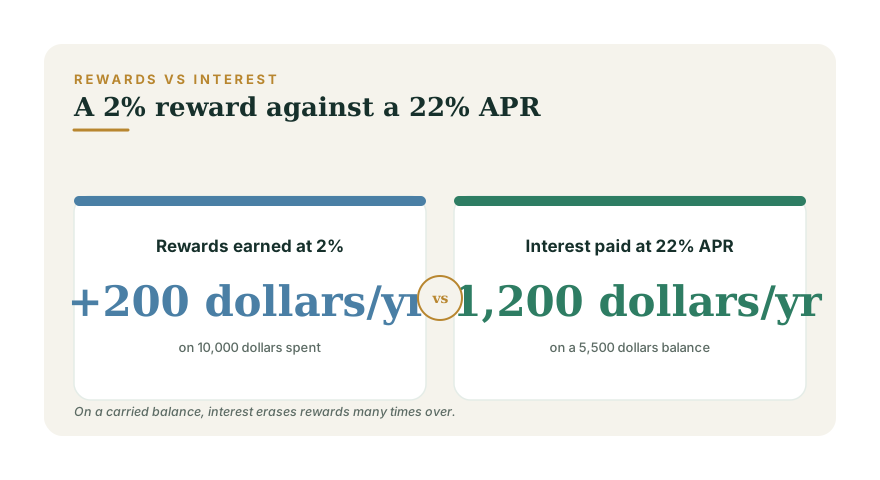
Suppose you put 10,000 dollars a year through a flat 2% cash back card. That is 200 dollars in rewards. Good so far.
Now suppose you carry an average balance of 5,500 dollars across the year at a 22% APR. Interest is roughly 5,500 times 0.22, which is about 1,210 dollars a year. Subtract your 200 dollars in rewards and you are down about 1,010 dollars. The card did not pay you. It charged you a four-figure fee and gave you a small rebate to soften the sting.
The break-even point is brutal. To make 200 dollars in rewards worth keeping a 22% balance, you would need to owe less than about 900 dollars on average for the whole year, because 900 times 0.22 is roughly 200 dollars. Carry more than that and your rewards are underwater. Most people who revolve a balance owe far more than 900 dollars.
There is a deeper trap. Studies of spending behavior repeatedly find that people spend more when paying with a card than with cash, often 10-20% more. So even a disciplined payer should ask whether the rewards are real savings or just a small kickback on inflated spending.
When Rewards Actually Work
Rewards are genuinely free money under one condition: you pay your statement balance in full, every single month, on time. Do that and you never touch the interest machine. The bank pays you out of merchant fees and gets nothing back from you. This is the only scenario where the marketing is honest.
If you are in that group, the strategy is straightforward. Pick a card whose rewards match your real spending, value points conservatively at about 1 cent each, and never let an annual fee exceed the value you actually extract.
How to Protect Yourself
The order of operations matters. Chasing rewards while carrying a balance is like arguing about the thermostat while the house is on fire. Put out the fire first.
- If you carry any balance, stop optimizing rewards and attack the balance. The interest rate is your real return on every dollar you pay down, and 22% guaranteed beats any reward.
- Calculate your personal break-even: divide your annual rewards by your APR. If your average balance is higher than that number, the card is costing you money.
- Set autopay to the full statement balance, not the minimum. Minimum payments are engineered to keep you in interest for years.
- Treat the card as a payment tool, not a line of credit. If you cannot pay it off this month, you cannot afford the purchase yet.
- Ignore reward boosts that require you to spend more. A 5% category bonus on money you would not otherwise spend is not a 5% gain, it is a 95% loss.
The Decision Rule
- Do you pay your full statement balance every month? If no, rewards are irrelevant. Pay down debt first.
- If yes, does your card's reward rate beat a simple 2% flat card after any annual fee? If no, switch to the simpler card.
- Are you spending more to earn rewards? If yes, the rewards are a discount on waste, not a gain.
- Is your average carried balance below annual rewards divided by your APR? If no, you are losing money on the card.
Our Honest Recommendation
If you never carry a balance, a single no-fee 2% flat cash back card is the right answer for most people. It is boring, it requires no spreadsheet, and it quietly returns real money on spending you would do anyway. If you do carry a balance, the most valuable financial move available to you is not a better rewards card. It is a payoff plan and full-balance autopay. Earning 2% while paying 22% is a trade no one should make on purpose.
Run your own numbers before your next statement: take your annual spend, your rewards rate, your average balance, and your APR, and see which side of break-even you land on. Our wealth simulator and the calculators under tools can help you map a payoff timeline, and you can pressure-test the whole plan at your plan. The card is not the enemy. The balance is.