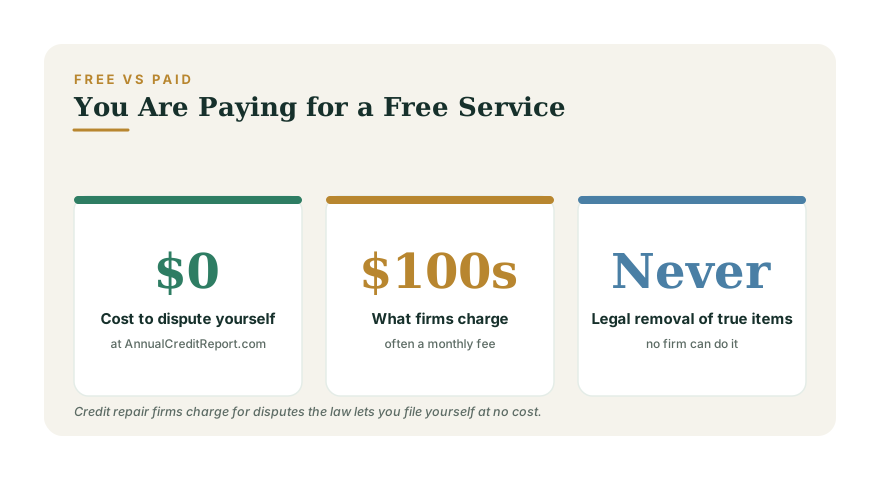
Credit repair companies sell a comforting fantasy: pay us, and we will make the bad marks on your credit report disappear. The reality is narrower and a lot cheaper. They mostly file disputes with the credit bureaus, which is something the law gives you the right to do yourself, for free, in an afternoon. And the one thing people most want, erasing accurate negative items, no company can legally do, no matter how the ads are worded. You are usually paying hundreds of dollars for a service you already own.
The honest truth: nobody can legally remove accurate bad marks
This is the line the whole industry blurs. If a negative item on your report is accurate, a late payment you actually made late, a collection you actually owe, no one, not you and not any company, has the legal power to force it off your report before it ages off on its own. Most negatives fall off after about seven years; a bankruptcy can stay up to ten. A credit repair firm cannot change that timeline. What they can do is dispute items, which only helps when an item is genuinely wrong. When the items are correct, all the disputing in the world achieves nothing except possibly getting an item temporarily removed and then re-added when it is verified. You paid for motion, not progress.
Follow the money
The business model depends on charging you for the work or for the wait. Some firms take a setup fee plus a monthly fee, so the longer your credit is troubled, the more they collect, which is a quiet incentive not to actually rush you to a fix. Federal law, the Credit Repair Organizations Act, specifically bans them from charging you before they perform the promised service and requires a written contract and a three-day right to cancel, precisely because so many of these operations took money up front and delivered nothing. When a whole category of business needs its own federal law to keep it from charging for work it has not done, that tells you what you are dealing with. The reputable end of the industry mostly just files the same free disputes you could file, then bills you for the postage.
Now the math
Put numbers on it. A common arrangement runs something like a 100 dollar setup fee plus 90 dollars a month. Stay enrolled for a year and that is 100 plus twelve times 90, or about 1,180 dollars. For accurate negative items, the result at the end of that year is the same result you would have gotten for free: the items age normally and your habits, on-time payments and lower balances, do the real work. The 1,180 dollars bought you nothing the law did not already give you.
Compare that to what your money does if you keep it. Paying down a credit card balance with that same 1,180 dollars directly lowers your credit utilization, which is one of the largest, fastest-moving factors in a credit score, and it saves you the 20%-plus interest the card was charging on that balance. So the choice is not "spend 1,180 dollars to fix my credit" versus "do nothing." It is "spend 1,180 dollars on a service that cannot help with accurate items" versus "put 1,180 dollars toward the exact thing that actually raises the score." One of those options is plainly better, and it is the free one.
There is one more cost the ads never mention: the dispute-spam tactic some firms rely on can actively backfire. Flooding the bureaus with disputes against accurate items, hoping a creditor fails to respond in time, occasionally gets an item temporarily dropped, but creditors routinely re-report verified accounts, so the mark comes back. Worse, a bureau can flag a pattern of frivolous disputes, which slows down the legitimate ones you might genuinely need later. You can pay hundreds of dollars and end up with a messier file than you started with, all for an outcome you could have reached for free by simply waiting and paying on time.
How to protect yourself
Everything a credit repair firm legitimately does, you can do better and free. Here is the DIY cleanup that actually moves the number.
- Pull all three reports for free at AnnualCreditReport.com, the only federally authorized source, and read them line by line.
- Dispute genuine errors directly with each bureau, online or by mail. The bureau generally must investigate within about 30 days and remove anything it cannot verify.
- Pay every bill on time, every month. Payment history is the single biggest factor, and time plus consistency is what heals a score.
- Drive your credit utilization down, ideally below 30% and lower if you can. Paying down balances is the fastest legitimate boost available.
- Keep old accounts open so your average account age stays high, and be patient. Negative items lose weight as they age even before they fall off.
The honest recommendation
Skip the credit repair company. For accurate marks, there is nothing to repair, only time and better habits, and for errors, the dispute process is free and squarely in your control. Know your rights under the Credit Repair Organizations Act: no firm can charge you before doing the work, everything must be in writing, and you can cancel within three days. If a company guarantees it can remove accurate items or wants money up front, it is breaking the law or about to disappoint you, and often both.
Start today: pull your free reports, dispute anything genuinely wrong, and point every spare dollar at paying balances down rather than at a monthly fee. Map the payoff and watch the score factors in your plan, track your progress with scores, and use the articles to understand exactly what each factor does. The fix is real, it works, and it costs nothing but attention.