When you are inside a debt spiral, where minimum payments barely dent the balance and new interest keeps undoing your progress, it feels like a hole with no bottom. The most important thing to know is that this feeling is almost always worse than the reality. Recovery has a clear sequence, and most people climb out faster than the panic in their head predicts. You do not need a windfall or a miracle. You need a plan and a few months of consistency.
The honest truth: recovery is faster than the fear
The spiral feels endless because of how interest compounds against you, but that same momentum reverses once you change the inputs. The moment you stop adding new debt and start putting real dollars against the principal, the math flips from working against you to working for you. People routinely go from feeling hopeless to having a clear payoff date within a single month of building an actual plan, even though the payoff itself takes longer. The dread is the heaviest part, and a plan lifts it almost immediately.
Step 1: Stop the bleeding
You cannot bail out a boat while water is still pouring in. Before anything else, stop adding new debt. Take the credit cards out of your wallet, freeze them, delete the saved card numbers from your shopping apps. Then write down every single debt: the balance, the minimum payment, and most importantly the interest rate. You cannot fight what you have not measured, and seeing it all in one place is usually less terrifying than the vague monster in your imagination.
Step 2: Build a tiny starter emergency fund
This step feels backward, but it is the one that prevents relapse. Before you throw everything at the debt, save a small buffer of 500 to 1,000 dollars. Here is why: if you have zero cash and the car breaks down, you go straight back to the credit card, and the spiral restarts. A small cushion absorbs the inevitable surprise so it does not undo your progress. It is the difference between a recovery that sticks and one that collapses on the first flat tire.
Step 3: Triage by interest rate
Now attack the debt itself. Make minimum payments on everything to stay current, then throw every extra dollar at the highest-rate debt first, because that is the one growing fastest against you. A 24% credit card is doing far more damage than a 6% car loan, so it dies first. When it is gone, roll that payment to the next-highest rate. If you need early psychological wins to stay motivated, it is fine to knock out a small balance first instead; the method you actually finish beats the one that is optimal on paper.
Step 4: Negotiate and use hardship programs
Most people never realize how much room there is to negotiate, because lenders do not advertise it. If you are struggling, call your card issuers and ask directly about hardship programs. Many will temporarily lower your interest rate, waive fees, or set up a structured payment plan, because a borrower on a reduced plan is far better for them than one who defaults entirely. It is an uncomfortable phone call that can save you thousands. Ask, specifically, for a hardship plan or a rate reduction, and write down who you spoke to and what they agreed to.
Step 5: Get real help, and avoid the predators
This is where the industry preys on desperate people, so the distinction here matters enormously.
- Nonprofit credit counseling (the good kind). Reputable nonprofit agencies, including members of the National Foundation for Credit Counseling (NFCC), offer free or low-cost budgeting help and can set up a debt management plan that consolidates your payments and often lowers your rates through agreements with creditors. This is legitimate help.
- For-profit debt settlement (the risky kind). These firms tell you to stop paying your creditors and instead pay them, while they supposedly negotiate to settle your debts for less. In the meantime your accounts go delinquent, your credit gets wrecked, late fees pile up, you may get sued, and forgiven debt can be taxed as income. They charge hefty fees for a process that frequently leaves people worse off. Be extremely cautious.
- Credit repair companies. They charge monthly fees to dispute items on your report that you can dispute yourself for free, and they cannot legally remove accurate negative information. There is nothing they do that you cannot do for nothing.
The 24-month rebuild roadmap (a checklist)
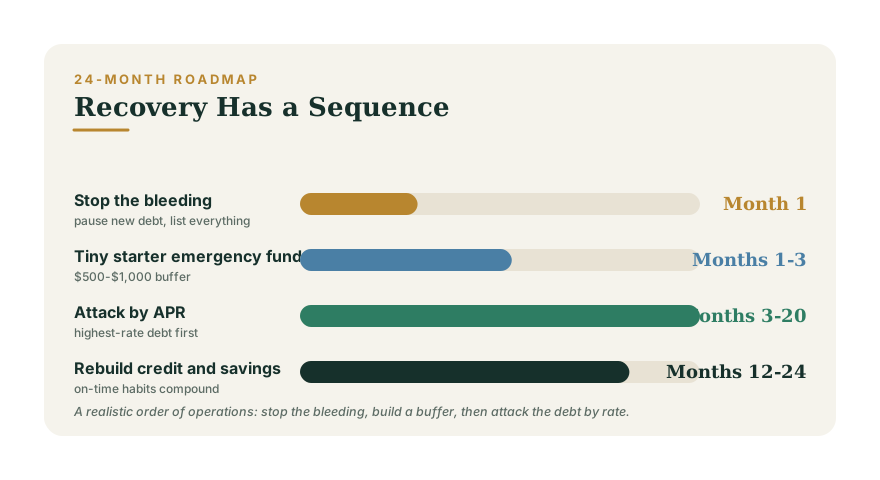
- Month 1: Stop new debt. List every balance, minimum, and rate. Build a bare-bones budget.
- Months 1-3: Save a 500 to 1,000 dollar starter emergency fund. Call lenders about hardship programs.
- Months 3-20: Attack debt by interest rate (or smallest balance if you need momentum). Roll each freed-up payment to the next debt.
- Months 6-12: If overwhelmed, get free help from a nonprofit credit counselor. Avoid for-profit settlement and credit repair firms.
- Months 12-24: As balances fall, your score climbs from on-time payments and lower utilization. Begin growing the emergency fund toward a full three to six months.
- Throughout: Automate every payment so progress does not depend on willpower each month.
Your credit score recovers with consistent behavior, not with tricks. On-time payments and a falling balance are the two biggest levers, and both improve automatically as you work the plan. Many people see meaningful score gains within a year of steady progress.
The honest recommendation
Do not wait for motivation or a perfect moment. Recovery starts the day you stop adding debt and write down the real numbers, and it almost always moves faster than you fear. Build the tiny buffer, triage by rate, negotiate where you can, and get free nonprofit help if you need it, while steering clear of the for-profit firms that profit from your panic. Consistency, not intensity, is what wins this.
Start by laying out every debt, rate, and payment in your plan so you can see the whole picture and a realistic payoff date. Model the timeline with the tools, and read our deeper guides on payoff methods and avoiding consolidation traps in the articles. The hole has a bottom, and you are closer to it than you think.