You buy a $2,000 sofa on a store card promising "No interest if paid in full within 12 months." You pay it down faithfully, but in month 12 a $30 balance is left over. The next statement shows a $400-plus interest charge. That is not a billing error. That is deferred interest doing exactly what it was designed to do, and it is the single most misunderstood phrase in consumer credit.
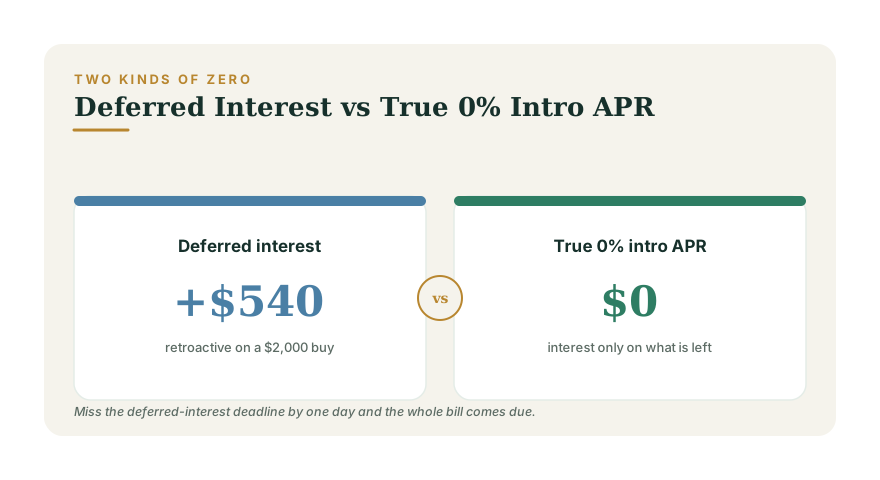
There are two completely different things hiding behind the word "zero," and the gap between them can cost you hundreds of dollars.
The Honest Truth: Deferred Interest Is Not 0% Interest
A true 0% intro APR means interest does not accrue during the promotional window. If a balance remains when the promo ends, you pay the normal rate going forward on whatever is left. Nothing reaches backward.
A deferred-interest offer is the opposite. Interest accrues from day one. It is simply hidden. If you clear the entire original balance before the deadline, the bank waives all of it. If you miss by even one dollar or one day, the bank charges you every penny of interest that quietly piled up on the full original purchase, not the small leftover. This is the structure on most furniture, electronics, jewelry, and medical financing cards.
The tell is the language. "No interest if paid in full by" or "special financing" almost always means deferred interest. "0% intro APR for 15 months" on a regular credit card almost always means true 0%.
Follow the Money
Deferred interest exists because lenders know how people actually behave. Studies of these promotions consistently find that a large share of borrowers, often more than a third, fail to pay off the balance in time. The retailer makes the sale, the lender books a chunk of high-rate interest, and the customer who was sure they would pay it off becomes the profit center.
The minimum payment is the trap inside the trap. The card sets a minimum that does not pay off the balance by the deadline. Pay only the minimum and you are mathematically guaranteed to trigger the retroactive charge. That is not an accident of design.
The Math
Say you finance a $2,000 purchase with 12-month deferred interest at a 27% APR. You pay the minimum, around $50 a month, and reach the deadline with roughly $1,400 still owed. Now the deferred interest lands: 27% applied retroactively across the year on the original $2,000 works out to roughly $540 of interest billed in a single statement. Your $2,000 sofa just became a $2,540 sofa, and you still owe the $1,400.
Compare a true 0% balance transfer done right. You move $5,000 onto a card offering 0% for 15 months with a 3% transfer fee. The fee is $150 up front. Divide $5,000 by 15 months and pay $334 every month. You finish on schedule, pay zero interest, and your total cost is the $150 fee, an effective rate of about 2.4% over the period. That is a genuinely useful tool when used with discipline.
How to Protect Yourself
The danger is never the 0% itself. It is the gap between the promo math and human behavior. Close that gap on purpose.
- Read for the trigger words. "No interest if paid in full" and "special financing" mean deferred interest. Assume the worst and confirm.
- Find the exact deadline date and the exact payoff amount, then set a calendar reminder for one full statement cycle before it.
- Ignore the minimum payment. Divide the balance by the number of promo months and pay that fixed amount automatically every month.
- Aim to finish a month early. A processing delay should never be the reason you trigger a retroactive charge.
- On balance transfers, count the fee. A 3-5% fee is real money. It is only worth it if your old rate was higher and you will actually clear the balance before the promo ends.
Your Decision Rule
- If the offer says "no interest if paid in full," treat it as a high-interest loan unless you can pay the whole thing off early with certainty.
- If it is a true 0% intro APR or balance transfer, divide the balance by the promo months and autopay that amount, no exceptions.
- If you cannot commit to the fixed monthly payment, the promo is not for you. Skip it.
- Never let the minimum payment set your pace. It is engineered to fail.
The Honest Recommendation
True 0% balance transfers are a legitimate way to kill high-interest debt, as long as you respect the fee and the deadline. Deferred-interest store financing is a different animal: it is a bet that you will slip up, and the house wins more often than not. If you would not pay the purchase off in full this month anyway, the financing is probably costing you more than the sticker hides.
Before you sign anything at the register, run the real numbers. Drop your balance and the promo length into our wealth simulator, build the payoff schedule in your plan, and the single most important move is also the simplest: divide the balance by the promo months and pay that exact amount every single month.